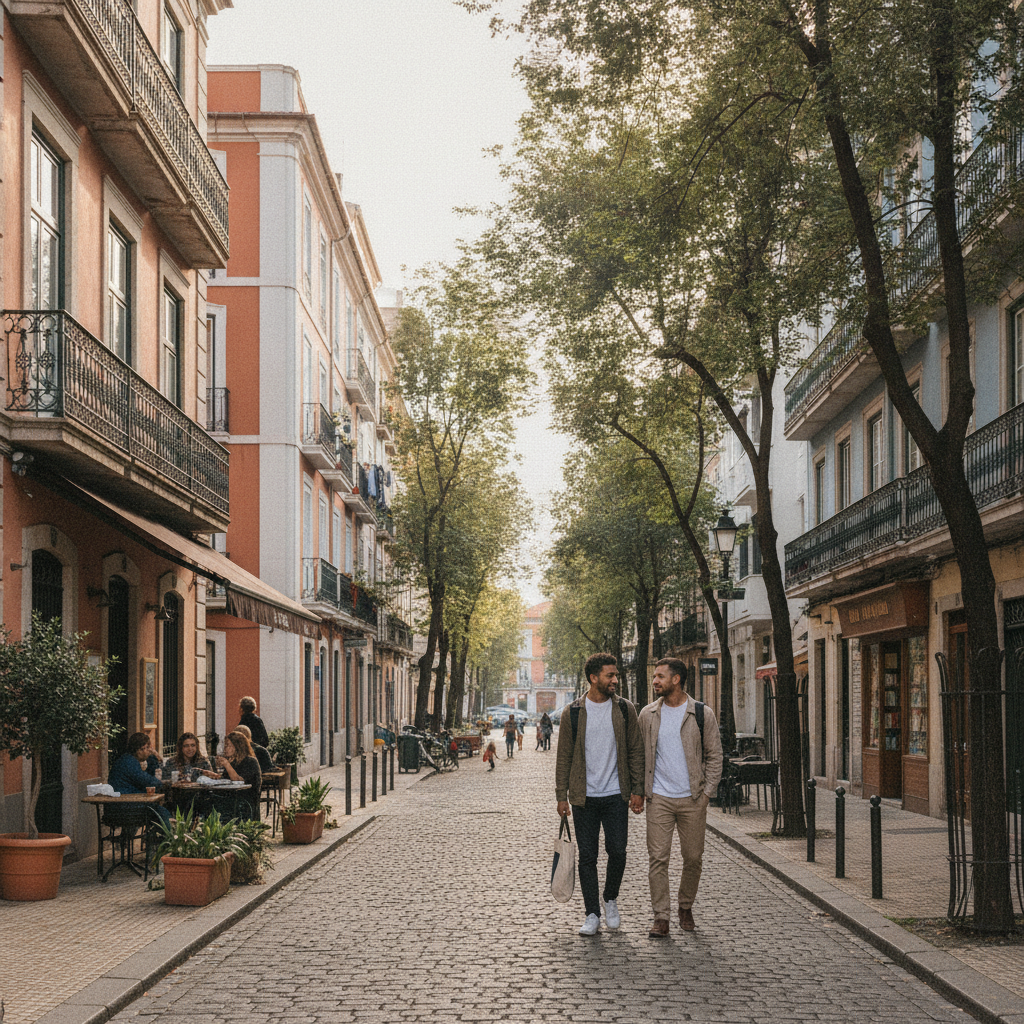
There is a particular kind of stillness that settles over a traveler who wakes up not to the ambient hum of a hotel corridor, but to the sound of a neighbor's door closing, a bicycle bell, or the distant clatter of a market stall opening for the day. That quiet revelation — that life is already underway, and you are briefly part of it — rarely arrives in the curated calm of a downtown hotel district. It arrives in the residential streets that most guidebooks treat as mere connective tissue between attractions, the places where a city actually lives rather than performs.
The Geography of Ordinary Life
Hotel districts are designed for transit. They organize themselves around airports, convention centers, and landmarks, and they do this efficiently, which is precisely their limitation. The traveler who books a room in central Lisbon's Baixa neighborhood or near Tokyo's Shinjuku station gains proximity to monuments but loses proximity to the rhythms that give those monuments meaning. Residential neighborhoods — the kind where the same café owner has worked the morning shift for a decade, where children walk to school in clusters, where grocery shopping happens daily rather than in weekly bulk — operate on a different tempo entirely. Spending even a few nights embedded in that tempo shifts the entire interpretive frame through which a city is understood.
The Japanese concept of *ma* — the meaningful pause or interval between things — applies here in an unexpected way. In a hotel district, every moment is filled: the concierge, the breakfast buffet, the lobby bar. In a residential neighborhood, there are gaps. A traveler sits on a stoop waiting for a café to open, watches a woman water her window boxes, overhears a conversation in a language they don't speak but whose emotional register they understand perfectly. Those gaps are not dead time. They are the texture of a place, and they accumulate into something that feels, by the end of a trip, more like genuine knowledge than a highlight reel ever could.
What Proximity to Daily Commerce Reveals
One of the most immediate differences is the relationship to food and commerce. Hotel districts concentrate restaurants around the traveler's convenience, which tends to mean higher prices, translated menus, and kitchens calibrated to international palates. Residential neighborhoods offer something closer to the French concept of *terroir* — the idea that a place's character is expressed through its most local and unremarkable products. The corner bakery in Barcelona's Gràcia neighborhood, the wet market two blocks from a guesthouse in Penang, the family-run trattoria in a Roman quartiere that seats twelve people and changes its handwritten menu daily: these are not hidden gems in any dramatic sense. They are simply what is there, unremarkable to locals and quietly revelatory to anyone paying attention.
Shopping at a neighborhood market rather than eating every meal at a restaurant also changes the pace of a trip. It introduces small negotiations, moments of pantomime communication, the minor triumph of identifying an unfamiliar vegetable and figuring out what to do with it. These are not grand experiences, but they are cumulative ones, and they tend to linger in memory long after the famous museum has faded to a vague impression of marble floors and crowd noise.
The Architecture of Belonging
Residential neighborhoods are also where architectural vernacular survives. Hotel districts, almost by definition, trend toward the legible and the universal — glass towers, branded interiors, streetscapes that could belong to any prosperous city on earth. But the quartiers, barrios, and wards that developed organically over generations carry a visual specificity that is impossible to manufacture. The wrought-iron balconies of New Orleans' Tremé neighborhood, the narrow lanes of Istanbul's Balat district with their painted wooden houses, the low-slung terrace housing of Melbourne's Fitzroy with its tiled front porches — these places are archives of decisions made by ordinary people across many decades, and walking through them is a form of reading that no tour bus can replicate.
That specificity extends to social life. A traveler staying in a residential neighborhood is more likely to be recognized, however briefly, as a recurring presence. The man at the corner kiosk learns your preferred newspaper. The woman at the fruit stall knows you always buy too many figs. These are tiny recognitions, almost weightless, but they do something important: they shift the traveler's self-perception from spectator to temporary participant.
Making the Shift in Practice
For those accustomed to booking by location rating alone, choosing a residential base requires a slightly different approach. Platforms like Airbnb and Vrbo make it relatively straightforward to filter by neighborhood, and reading the host's description for phrases like "quiet street," "local market nearby," or "residential area" tends to be more reliable than star ratings. It also helps to research the city's internal geography before booking — understanding that Rome's Pigneto district sits east of the center, or that Kyoto's Fushimi ward has a neighborhood fabric distinct from the temple-heavy northern districts, gives the search more precision.
The practical adjustments are minor. Public transit becomes more central to the daily routine, which is itself an education — learning a metro system, reading bus schedules, understanding which lines locals actually use rather than which ones appear on tourist maps. Some amenities that hotels provide as standard require a little planning: laundry, reliable Wi-Fi, a quiet workspace. But these are the small frictions that, counterintuitively, make a trip feel more real.
The traveler who returns from a city able to describe not just its monuments but the way its streets smell in the early morning, the particular light in a neighborhood square at dusk, the sound of domestic life filtering through an open window — that traveler has received something that no hotel district, however well-appointed, tends to deliver. The stillness that greeted them on the first morning, unfamiliar and slightly disorienting, will have become, by the last, something they recognize as the sound of a place they briefly knew.