There is a particular kind of loneliness that settles over a traveler eating alone at a table meant for four — surrounded by the ambient noise of a city they don't yet understand, scrolling through a phone while the real conversation of the place happens just beyond reach. Most people, when arriving somewhere unfamiliar, instinctively retreat to the comfort of a booth or a window seat, a private enclave from which the city can be observed at a safe distance. But the counter seat offers something fundamentally different: not observation, but participation. It is one of the most underused tools in the curious traveler's repertoire, and the cultures that have long understood this have built entire social rituals around it.
The Counter as Social Architecture
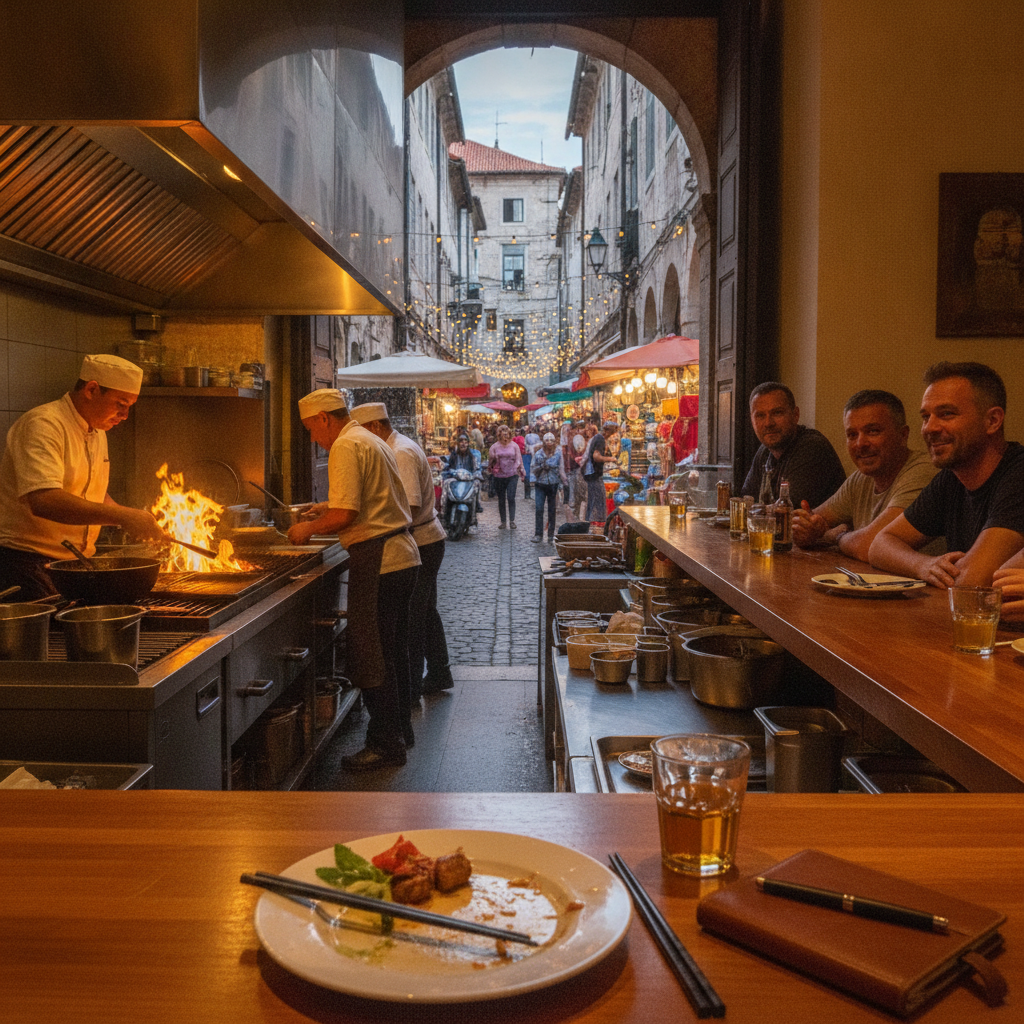
In Japan, the concept of *ichiju sansai* — a meal philosophy built around simplicity and seasonal balance — finds its most honest expression not at formal dining tables but at the wooden counters of tiny neighborhood restaurants called *izakayas* or *kappo* establishments. At these counters, the cook is also the host, the kitchen is the centerpiece, and the diner is implicitly invited into the rhythm of preparation. This spatial arrangement is not accidental. The counter collapses the distance between producer and consumer in a way that a table never can, turning a meal into something closer to a performance witnessed together. Cities like Osaka and Kyoto have built entire culinary identities around this intimacy, and visiting one without sitting at a counter is, in some ways, missing the point entirely.
The same logic applies across cultures, though the aesthetics shift considerably. In Barcelona's La Boqueria market, the small counter bars tucked between produce stalls serve *pintxos* and cured meats to locals who eat standing up, elbow to elbow, between errands. In New York's Koreatown along 32nd Street, counter seating at late-night *pojangmacha*-style spots draws a mix of cooks, cab drivers, and office workers who would never share a table but somehow share a counter without a second thought. The physical structure of the counter — linear, open, facing inward — creates a social equality that booth seating quietly denies. Everyone can see what everyone else is eating. Conversation becomes natural rather than intrusive.
What Gets Lost at the Table
The standard restaurant table, particularly in Western hospitality culture, is designed to create privacy. Seats face each other within a contained group, the surrounding room recedes, and the meal becomes an inward-looking event. This is ideal for anniversaries and business dinners. It is less ideal for anyone trying to understand how a city actually feeds itself. At a table, a traveler remains a visitor. At a counter, the same traveler becomes something more like a temporary regular — subject to the same idle commentary from the cook, the same recommendation when the daily special runs low, the same offhand observation about the weather or the neighborhood that locals exchange without thinking.
This shift is more significant than it might appear. Local food culture is not primarily transmitted through guidebooks or curated food tours — it lives in exactly these small, unrepeatable exchanges. The cook at a *tacos de canasta* counter in Mexico City's Tepito neighborhood who explains, without being asked, why Monday's beans taste different from Friday's is offering something that no restaurant review captures. The fishmonger who doubles as a lunch counter operator in Tsukiji's outer market district in Tokyo, slicing tuna with the same knife he's used for decades, communicates a relationship with ingredients that is effectively untranslatable — but it can be witnessed, and absorbed, by anyone willing to sit down and pay attention.
Reading a City Through Its Counter Culture
Every city that has a strong counter-eating tradition also tends to have a strong sense of culinary identity — the two are not coincidental. Counter eating demands a certain confidence from the kitchen: there is nowhere to hide imprecision when the diner is watching every move. It also demands a certain honesty from the menu, since counter spots rarely have the square footage for elaborate presentations or lengthy ingredient lists. What survives in that environment is what the culture genuinely values. In New Orleans, the counter at a classic po'boy shop like Parkway Bakery in Mid-City communicates something essential about the city's relationship with bread, heat, and abundance that a sit-down meal at a fine dining establishment simply doesn't replicate. The informality is the point. The lack of ceremony is where the meaning lives.
For travelers who want to move beyond the surface of a place, the counter seat is less a dining choice and more a method. It requires a degree of openness — a willingness to eat without the buffer of companions or the protection of a reserved table — but it rewards that openness generously. Cities reveal themselves to the people who are willing to sit still in an unguarded way, and the counter, more than almost any other setting in urban life, makes that kind of stillness possible.
Finding the Right Counter in Any City
When you arrive somewhere unfamiliar, the instinct to research extensively before eating is understandable, but it can also become a way of pre-filtering the experience into something safer and more familiar than the city actually is. Apps like Google Maps and Eater's city guides are useful for orientation, but the best counter seats are often in places that haven't been written about recently — the ones that don't need to be. A useful practice is to walk a neighborhood at meal-adjacent hours, around mid-morning or the hour before lunch, and watch where the aproned workers from nearby businesses are heading. Follow that current, find the counter, and sit down. Order what someone nearby is already eating. The city, in its own time and on its own terms, will begin to make itself known.
There is a kind of traveler who returns from a trip with photographs of monuments and menus, and another kind who returns carrying something harder to articulate — a felt sense of how a place moves through its days. The counter seat, in all its various cultural forms, is one of the most reliable ways to become the second kind of traveler. It asks very little and offers, in return, a window into the daily life of a city that no formal itinerary can manufacture. The lonely traveler at the table for four is still waiting for the city to come to them. The one at the counter has already started the conversation.