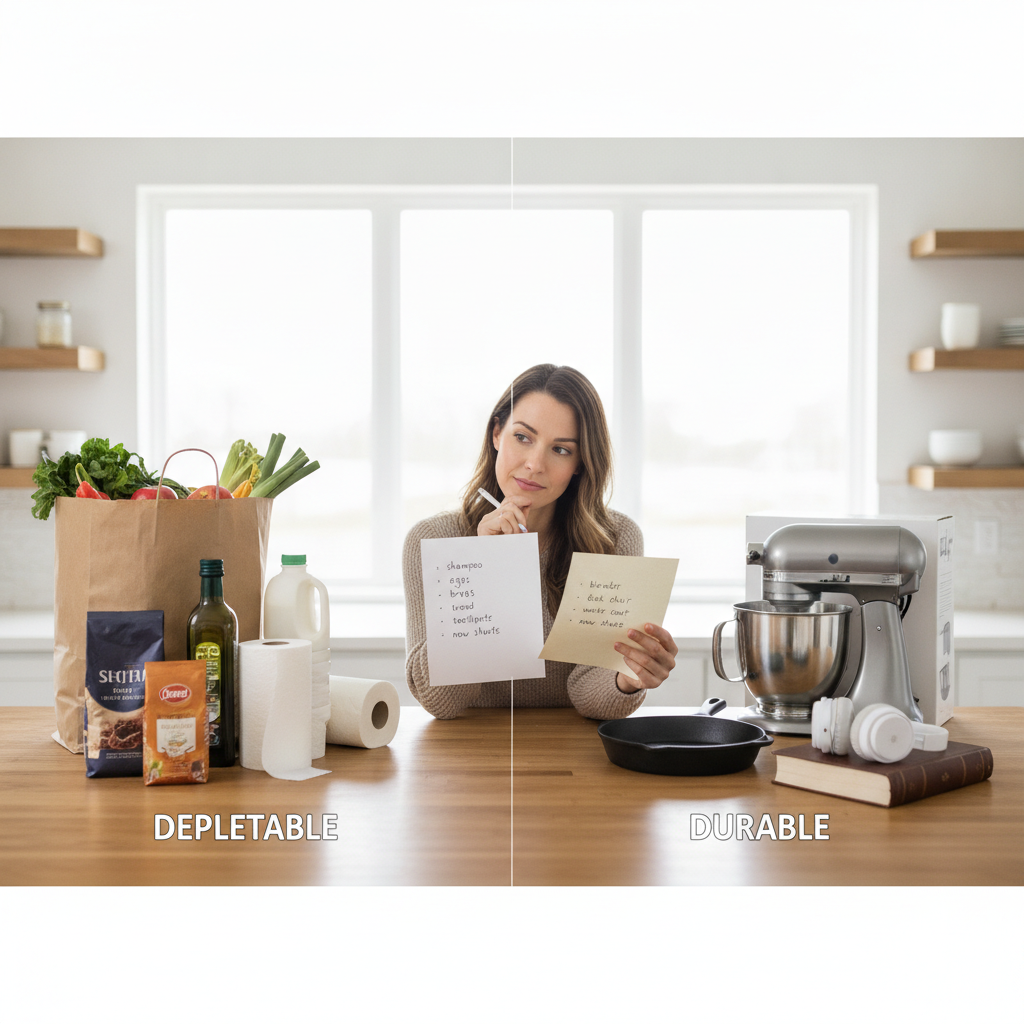
Major sale events are engineered to blur the line between what you need and what you're simply persuaded to want. Whether it's a Black Friday weekend, an Amazon Prime event, or a Costco seasonal blitz, the mechanics are the same: time pressure, visual abundance, and discount framing conspire to make almost any purchase feel justified. One practical antidote — separating your list into depletable and durable categories before the sale begins — reframes every deal you encounter against an objective standard you set in advance.
If you've ever walked away from a major sale having bought more than you planned, and still somehow felt like you made sensible decisions, this framework is worth building into your pre-sale routine.
Understand What Makes a Purchase Depletable or Durable
Depletable items are things you use up and replace at a predictable rate: cleaning supplies, pantry staples, personal care products, printer ink, pet food. Durable items are things you buy once and use for years — appliances, clothing, furniture, electronics, cookware. The distinction matters because the economics of buying ahead are fundamentally different for each category. Stocking up on laundry detergent during a Target Circle sale is a straightforward win. Buying a KitchenAid stand mixer because it's discounted — when you hadn't planned to own one — is a different kind of decision entirely.
Build Your Depletable List From Actual Usage Patterns
Before any major sale, spend ten minutes auditing what you genuinely go through. Check under the bathroom sink, the cleaning cupboard, and the pantry. Your depletable list should reflect what you're already consuming, not what you might start consuming. Buying six bottles of a shampoo you've never tried because it's on sale at Ulta is not strategic — it's hopeful. Buying six bottles of the shampoo you've used every month for two years is. The list filters out novelty purchases disguised as bulk efficiency.
Build Your Durable List Around Replacement, Not Upgrade
For durable items, the right question isn't "is this a good deal?" — it's "does something I own need replacing?" A Dyson vacuum at forty percent off is only a sound purchase if your current vacuum is failing or you don't own one. A new iPad is a deal only if your current device is genuinely limiting your work or daily use. Keeping a short running list of durables that are worn, broken, or approaching end of life gives you a ready filter. When the sale arrives, you check against the list — not against the sale catalog.
Set a Depletable Spending Ceiling Before You Browse
Even within the depletable category, there's a natural tendency to overbuy. Bulk pricing is persuasive, and warehouse stores like Costco are designed to make large quantities feel responsible. Before the sale, decide how much storage space and how many months of supply is actually practical. Buying a year's worth of paper towels might make mathematical sense, but if it takes up half a closet, the real cost includes inconvenience. A sensible ceiling — say, a two to three month supply for most items — keeps the depletable list functional rather than aspirational.
Apply a Cooling Window to Any Durable Not Already on Your List
If you encounter a durable item during a sale that wasn't on your pre-built list, treat it as a new decision rather than an opportunity. One effective approach is the 72-hour rule: note the item, check whether the deal is genuinely time-limited, and return to it only after you've had space to evaluate it against your actual life. Many sales that feel finite aren't — retailers extend pricing, or the same discount appears again within weeks. Removing urgency from an unplanned durable purchase almost always produces a clearer answer.
Use Price-Tracking Tools to Validate Durable Deals
Not every discount on a durable item represents the best available price. Browser extensions like Honey or CamelCamelCamel (for Amazon purchases specifically) show pricing history, which frequently reveals that a "sale" price is close to the item's regular going rate. This is especially common around major retail events, where list prices are sometimes inflated before being discounted. Checking a price history before committing to any durable purchase takes under two minutes and removes one of the most common ways sale events manufacture a sense of urgency.
Review the List Together If You Share a Household Budget
If you shop for a household rather than just yourself, building the depletable and durable lists collaboratively before a sale event prevents duplication and catches blind spots. One person might know the household is nearly out of olive oil; another might know the blender is on its last legs. A shared note in Google Keep or a simple shared document takes five minutes to set up and eliminates the category of purchases that seem reasonable in isolation but create redundancy or conflict when viewed together.
Treat the Post-Sale Review as Part of the System
After the sale ends, spend a few minutes reviewing what you bought against your original two lists. Did you stick to depletables you genuinely needed? Did any durable purchases fall outside the replacement criteria you'd set? The post-sale review isn't about self-criticism — it's data collection. Over time, patterns become visible: maybe you consistently overbuy in one category, or maybe a particular retailer's sale format reliably pulls you toward unplanned purchases. That awareness makes the next pre-sale list sharper.
As retail events grow more frequent and the window between major sales continues to compress, the pressure to act quickly on deals will only intensify. Building a simple categorical framework before each event — depletable versus durable, planned versus unplanned — keeps spending decisions anchored to real need rather than manufactured urgency. The list doesn't have to be elaborate. It just has to exist before the sale begins.