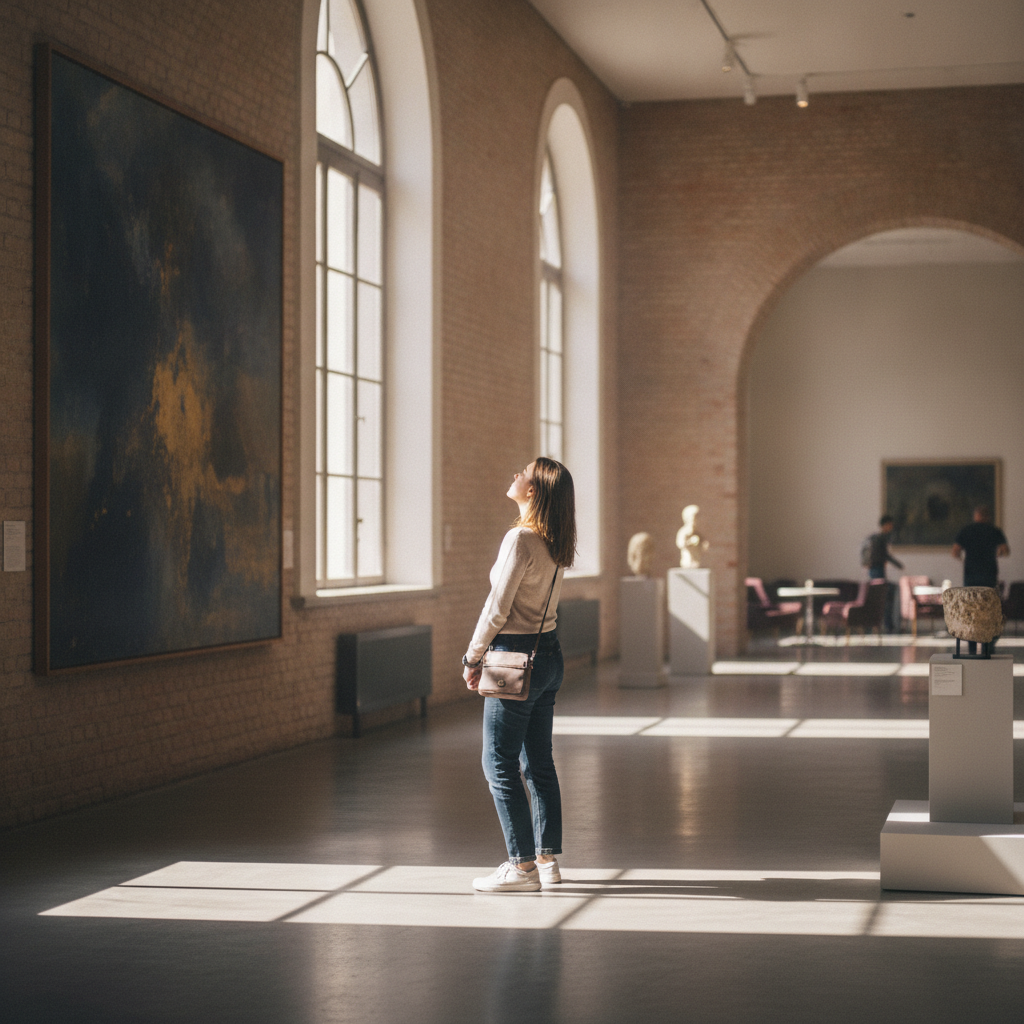
The most visited cultural sites in the world are, almost without exception, the least conducive to actually experiencing culture. There is a particular irony in standing shoulder to shoulder with thousands of strangers, phone raised above your head, trying to glimpse something that the crowd itself has rendered inaccessible — not just physically, but emotionally. The Louvre, the Colosseum, the Uffizi: these institutions hold genuine wonders, and yet the conditions under which most travelers encounter them have become antithetical to the quiet absorption that great art and history demand. A different approach exists, one that requires only a slight pivot in planning and a willingness to resist the gravitational pull of the obvious.
What Makes a Secondary Museum Worth Choosing?
The term *musée de quartier* — a neighborhood museum, in the French tradition — captures something that English doesn't quite have a word for: an institution rooted in a specific place, community, or narrow subject, rather than an ambition to represent everything. Secondary museums, whether dedicated to a single artist's life, a local craft tradition, or a forgotten chapter of civic history, tend to operate with a different philosophy than their blockbuster counterparts. They are rarely underfunded passion projects; many are exceptionally curated and staffed by specialists with deep knowledge of a tight subject. What they lack in scale they compensate for in coherence and intimacy.
How Does the Crowd Dynamic Shift the Quality of Attention?
Visitors to overwhelmed landmarks frequently describe a subtle but persistent anxiety — the sense of needing to move on, to yield space, to photograph rather than observe. This is not incidental. Cognitive overload and social pressure actively suppress the kind of slow, wandering attention that produces genuine engagement with objects and spaces. In a less crowded institution, the rhythm of a visit changes entirely. A traveler might spend twenty minutes with a single painting, or double back through a room that caught their interest, without any social friction. The Musée de la Chasse et de la Nature in Paris, for instance, draws a fraction of the traffic of the Centre Pompidou, yet consistently earns deeper reflection from those who find it.
Why Do Secondary Institutions Often Hold More Specific Treasures?
Large national museums acquire broadly, which means that genuinely exceptional objects frequently compete for attention against the weight of the entire collection. Smaller institutions, by contrast, are often built around a single extraordinary holding — a complete archive, a private collection donated intact, or a site of historical significance that never achieved mainstream fame. The Sir John Soane's Museum in London, crammed into a Georgian townhouse in Holborn, contains an Egyptian sarcophagus, Hogarth's original *Rake's Progress* paintings, and architectural drawings of startling ambition, all within rooms that Soane himself designed. The experience of that place is simply not replicable at the British Museum, regardless of how impressive the latter's holdings may be.
How Does Context Change What a Museum Communicates?
One of the less discussed dimensions of museum experience is *genius loci* — the spirit of place, a classical idea referring to the animating character of a specific location. Secondary museums often carry this quality more vividly than large institutions, because their physical setting is inseparable from their subject. A museum housed in the workshop where an artist actually lived and worked communicates something that a dedicated gallery wing in a national collection cannot, however faithfully it may reproduce the conditions. The Keats-Shelley House in Rome occupies the actual rooms where John Keats died in 1821; the experience of standing in that space produces a kind of temporal compression that no interpretive panel could manufacture.
What Role Does Serendipity Play in Smaller Cultural Venues?
Large-scale tourism operates on a logic of optimization — the itinerary, the timed entry, the audio guide keeping pace with the crowd. Secondary museums tend to disrupt that logic in useful ways. A conversation with a curator who happens to be adjusting a display, an unlabeled side room containing something extraordinary, an unexpected connection between two objects that a traveler notices because they have the space to look — these are the experiences that survive in memory long after the photographs from famous landmarks have blurred into sameness. Cities like Vienna, Amsterdam, and Kyoto are particularly rich with this kind of lateral discovery, rewarding travelers who look one or two stops past the obvious destination.
How Should You Identify the Right Secondary Museum for a Given Trip?
The selection process is less complicated than it might appear. A useful starting point is to identify the city's main cultural institution and then ask what it excludes or overshadows. Most major cities have a specialist museum dedicated to a single craft, industry, or period that the national collection treats as a footnote. Local tourism boards, neighborhood cultural foundations, and independent travel publications tend to surface these places more reliably than algorithmic travel platforms, which amplify whatever already draws traffic. The Museo Storico della Fisica e Centro di Studi e Ricerche Enrico Fermi in Rome, or the Museum of Brands in London's Notting Hill, represent the kind of specific, coherent institution that rewards a deliberate afternoon rather than a checked-off obligation.
Choosing Differently, Remembering More
When you step away from the most-photographed room in the most-visited building and into a quieter institution a few streets away, something shifts in how a city begins to feel. The pressure lifts. The experience becomes yours rather than a shared performance of having been somewhere. The opening observation holds: the most visited sites are often the least experienced. Secondary museums don't offer a consolation prize for missing the famous landmark — they offer something the famous landmark structurally cannot: time, space, and the kind of unhurried attention that turns an afternoon into a memory. That is, ultimately, what travel is for.