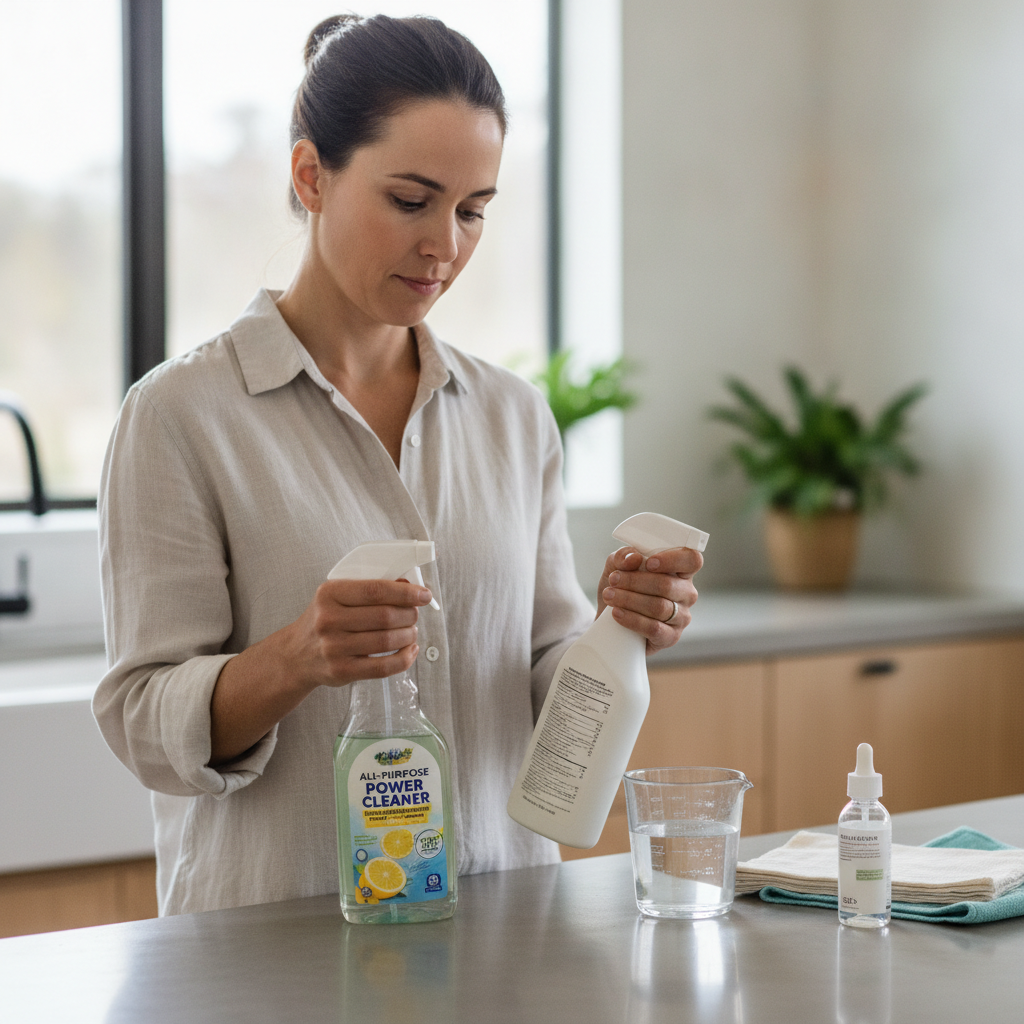
Cleaning product labels are designed to sell, not inform. The bold claims printed on the front of a bottle — "industrial strength," "deep clean formula," "maximum power" — are marketing language, not chemical guarantees. The actual story of what's inside a product lives in the ingredients list, typically printed in small type on the back or side panel. Shoppers who learn to read that list gain a practical advantage: they can compare products on the basis of what's actually in them, rather than what a brand wants them to believe.
Why Front-Label Claims Don't Reflect Formula Strength
The cleaning product industry operates under relatively loose labeling standards when it comes to marketing language. Terms like "concentrated," "professional grade," and "ultra" carry no regulated definition, which means two products with nearly identical formulas can be positioned at dramatically different price points based on branding alone. A budget store-brand all-purpose cleaner and a premium-branded alternative sometimes share the same active ingredients in nearly the same proportions. The difference in price reflects packaging, advertising spend, and perceived prestige — not meaningful differences in cleaning performance.
The Role of Active Ingredients in Cleaning Effectiveness
Every cleaning product works through a relatively small set of functional ingredients. Surfactants like sodium lauryl sulfate or alkyl polyglucosides are responsible for lifting grease and grime. Disinfectants such as benzalkonium chloride or hydrogen peroxide handle microbial load. Solvents like isopropyl alcohol dissolve residues that water alone can't shift. These are the ingredients that actually do the work. Everything else in the formula — thickeners, fragrances, colorants, stabilizers — affects texture, scent, and shelf life, but contributes little to cleaning power. Recognizing which ingredients matter allows consumers to evaluate products based on substance rather than sensory appeal.
How Water Positioning Signals a Diluted Formula
Ingredients lists on cleaning products, as with food and cosmetics, are ordered by concentration from highest to lowest. When water appears as the first ingredient — which it does in the vast majority of spray cleaners and multi-surface products — that's expected and not inherently a problem. The concern arises when water is followed immediately by additional low-concentration fillers before any active cleaning agent appears. In some heavily marketed products, the first meaningful surfactant or disinfectant doesn't appear until the fourth or fifth position, suggesting a formula that's more water and filler than active chemistry. Brands like Method, Mrs. Meyer's, and even some lines from Seventh Generation vary considerably in this regard across their product ranges.
Comparing Unit Price Alongside Ingredient Position
Reading ingredients becomes most powerful when combined with unit price comparison. A spray cleaner priced significantly higher than a store-brand alternative is only worth the premium if its formula is meaningfully different — more concentrated actives, fewer fillers, or the presence of ingredients the cheaper product lacks. When both products list the same surfactant in the second position and share a nearly identical supporting cast, the price gap is largely cosmetic. Retailers like Target and Walmart now display unit pricing on shelf tags consistently, making this side-by-side analysis straightforward. The combination of unit cost and ingredient order gives a far clearer picture of value than either data point alone.
What Concentrated Formulas Actually Look Like
Genuinely concentrated products have a recognizable signature in their ingredients lists. Active ingredients appear high in the order, the formula tends to be shorter overall, and the product is typically sold with dilution instructions. Brands like Zep and Simple Green have long positioned their products around this model, offering commercial-grade concentrates that, when diluted correctly, yield a much lower cost-per-use than ready-to-spray alternatives. Some newer direct-to-consumer brands have adopted tablet and powder formats that ship without water entirely, which further reduces both cost and packaging waste. These formats make the concentration question explicit rather than something consumers have to decode from a label.
Building a Smarter Cleaning Product Buying Habit
Applying this knowledge at the shelf doesn't require a chemistry degree — it requires a few minutes of comparison shopping and a basic familiarity with what to look for. When you're evaluating two similar products, flip both bottles over and scan the first three to five ingredients. If the premium-priced option leads with water, fragrance, and a thickener before reaching a surfactant, while the store brand puts its active ingredient in the second position, you're likely looking at a more diluted formula in the pricier bottle. Pay attention to whether a product includes dilution instructions — that's often a signal of genuine concentration. Over time, this habit becomes quick and instinctive, and the savings across a full household cleaning routine add up meaningfully over months of regular shopping.
The ingredients list is the only part of a cleaning product label that's required to be accurate. Front-of-pack claims are aspirational marketing; the back panel is functional chemistry. Shoppers who treat the ingredients list as their primary evaluation tool — rather than a secondary afterthought — consistently make better purchasing decisions, spending less for equivalent or superior cleaning performance. It's one of the more underrated skills in practical consumer literacy, and it costs nothing to develop.