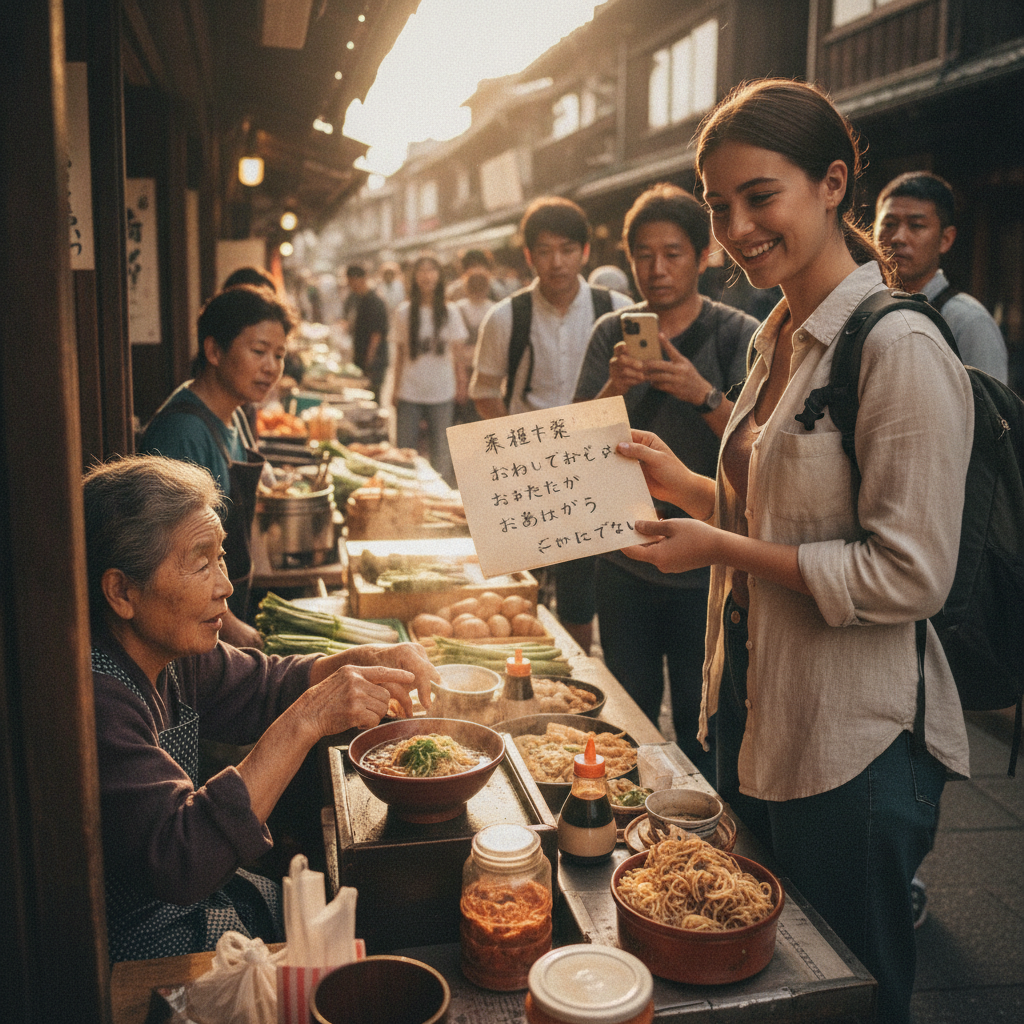
There's a particular kind of helplessness that settles in when you're standing at a street food stall in a country where you don't speak the language, phone signal is weak, and the translation app is spinning endlessly. You point, you smile, you hope. Most of the time it works out fine — but you leave the interaction feeling like a spectator rather than a participant. A small, laminated card covered in handwritten local script changes that dynamic entirely, and the shift it produces is more meaningful than it sounds.
The idea is straightforward: before you travel, you write out a handful of essential phrases not in romanized transliteration, but in the actual script used by locals. Devanagari in India, Arabic in Morocco, Thai in Bangkok, Hangul in Seoul. You hand it to someone, point to what you need, and something unexpected happens — their face changes. You stop being a tourist with a glowing rectangle and become a person who made an effort. That effort is currency in ways no app can manufacture.
Write the Card Before You Leave, Not at the Airport
The preparation window matters more than people expect. Sitting down two or three days before departure gives you time to consult multiple sources — Google Translate for a first draft, then a native speaker on a platform like iTalki or even a Reddit community dedicated to the destination country to verify accuracy. Phrases copied blindly from an app can contain subtle errors that confuse rather than communicate. Getting a human to glance over your card, even briefly via a free online forum, adds a layer of reliability that purely automated tools can't guarantee. Print the final version in a readable font size, or write it clearly by hand and laminate it with a cheap home kit.
Choose Phrases That Open Doors, Not Just Transactions
The temptation is to load the card with practical requests — where is the bathroom, how much does this cost, I'm allergic to nuts. Those belong on the card, absolutely. But the phrases that generate the warmest responses are the ones that acknowledge the other person rather than just extract information from them. A simple greeting in the local script, a phrase meaning "thank you, this is delicious," or "I'm trying to learn" does something different than a request. It signals respect. In countries like Japan and Turkey, where hospitality is deeply embedded in the culture, these small gestures tend to produce unsolicited kindness — an extra portion, a recommendation whispered with enthusiasm, an invitation to see something off the tourist trail.
Keep the Card Physically Small and Always Accessible
A card the size of a standard index card fits in a shirt pocket or the front pocket of a daypack. This matters because the moment you start fumbling through a bag or unlocking a phone, the spontaneous quality of the interaction evaporates. The whole point of the card is immediacy — you see an opportunity, you reach for it without friction. Laminating it protects against rain, spilled coffee, and the general wear of daily use. Some travelers keep two copies: one in their main bag and one on their person. The backup version has saved more than a few interactions on rainy evenings in narrow alleyways far from reliable Wi-Fi.
Let Locals Correct You — That's Part of the Value
One of the more unexpected benefits of presenting a handwritten phrase card is that it invites gentle correction. When someone sees you've made an effort but gotten something slightly wrong, they often can't help themselves — they'll point to the phrase, say the right version aloud, and watch you repeat it. Within minutes you're having a micro language lesson from someone who actually grew up speaking it. This kind of exchange doesn't happen when you hold up a phone screen. The card signals vulnerability and earnestness in a way that technology, for all its convenience, tends to flatten. Neighborhoods like Chefchaouen in Morocco or the backstreets of Chiang Mai are full of people who respond warmly to this kind of openness.
Use the Card to Start, Then Let the Conversation Evolve
The card is a door, not the whole house. Once you've used a phrase and gotten a response — even a smile and a nod — the conversation can move in unexpected directions through gesture, expression, and shared laughter at the language barrier itself. Many travelers report that their most memorable interactions abroad began with exactly this kind of imperfect, enthusiastic attempt to communicate. The card removes the paralysis of not knowing where to start. After that, human connection tends to find its own momentum without needing a perfect translation.
Tailor the Script to the Specific Region, Not Just the Country
Language isn't monolithic within borders. Arabic spoken in Marrakech differs from the Arabic of Cairo; Spanish in Oaxaca carries different idioms than Spanish in Madrid. When you're preparing your card, research the regional dialect or script variation that locals actually use daily. For a trip to Tamil Nadu in India, standard Hindi phrases won't open the same doors as Tamil ones. This level of specificity takes an extra hour of research, but it signals something locals rarely expect from visitors — that you paid attention to where you actually are, not just the country name on your flight booking.
Store a Photo of the Card on Your Phone as a Backup
Once your card is finalized, photograph it and save the image to your phone's camera roll with offline access enabled. If the physical card gets lost or damaged, you still have every phrase available without needing a data connection. Apps like Google Photos or Apple Photos can store images offline with the right settings adjusted before departure. This redundancy costs nothing and takes thirty seconds to set up. The goal isn't to replace the physical card — it's to ensure that one unlucky moment doesn't erase weeks of thoughtful preparation.
Add a Line That Explains What the Card Is
One refinement that experienced travelers swear by is adding a short explanatory sentence at the top of the card, written in the local script, that says something like: "I'm learning your language. Please point to what you'd like to tell me." This single addition transforms the card from a one-way broadcasting tool into an interactive object. It invites the other person to participate, to write something back, to point. The card becomes a shared artifact rather than a foreign object being waved in someone's face. In practice, this small detail tends to produce the most memorable exchanges of an entire trip.
The tools available for international travel keep getting more sophisticated, and translation technology will continue to improve. But the gap between efficient communication and genuine human connection isn't a technical problem — it's a human one. A pre-written phrase card in the local script doesn't solve the language barrier completely. What it does is demonstrate that you came prepared to meet people where they are, not just where your signal strength allows. That posture, more than any feature update, is what makes strangers want to help you.