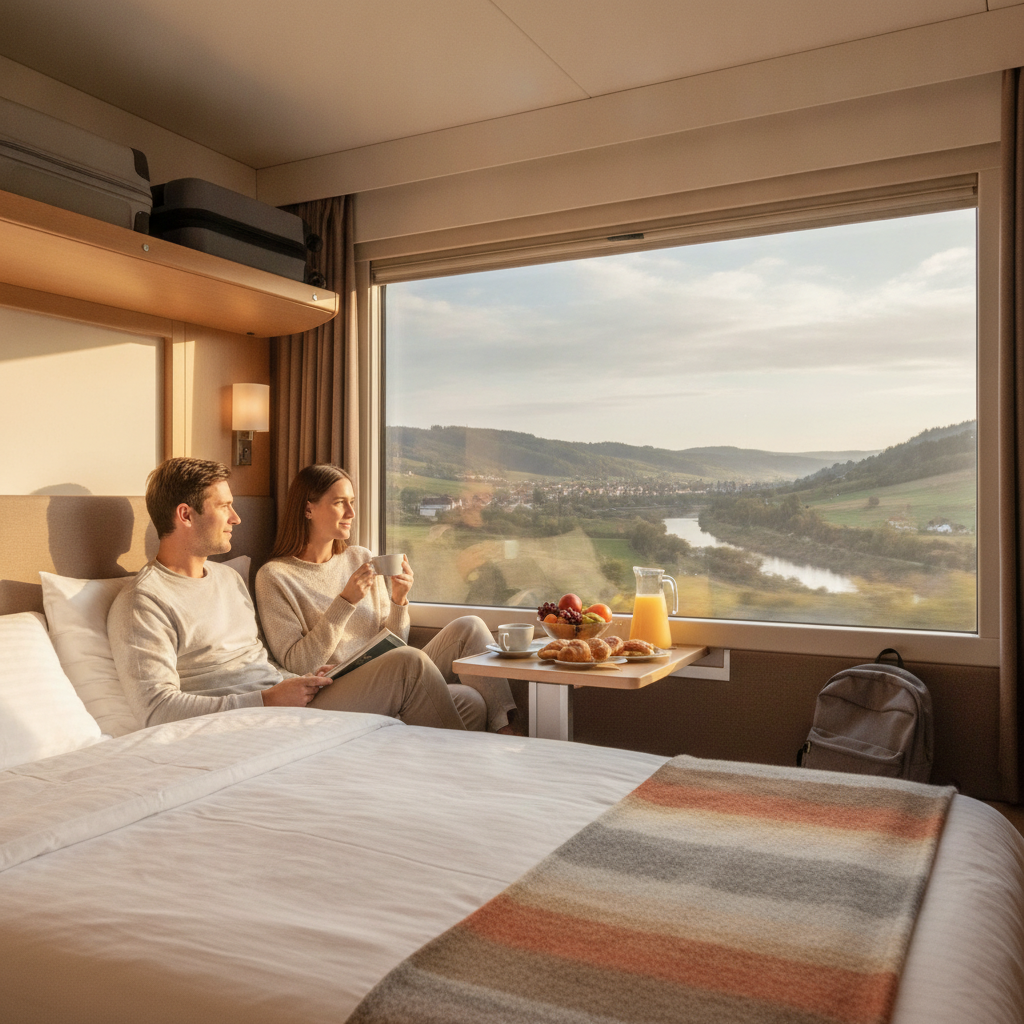
There is a particular kind of arrival that budget air travel has quietly normalized — the disoriented shuffle through a peripheral airport at dawn, luggage in hand, eyes adjusting to unfamiliar fluorescent light, the city itself still an abstraction somewhere beyond a highway and a crowded shuttle. The destination has been reached, technically, but nothing about the passage has prepared the traveler for it. The journey was simply something to be endured, compressed, survived. What overnight train travel proposes, by contrast, is something philosophically different: that the act of moving from one place to another can carry its own texture, its own rewards, and its own quiet sense of arrival before arrival even happens.
The Economics of the Overnight Equation
On the surface, budget flights appear to win the cost comparison with little contest. A low-cost carrier between major European cities or across Southeast Asia can price tickets at a fraction of what a sleeper berth on an overnight rail service costs. But the accounting changes considerably when the full picture is drawn in. Budget airlines typically situate their hubs far outside city centers — Beauvais for Paris, Stansted for London, Memmingen for Munich — meaning travelers absorb ground transport costs in both time and money at each end. Add an overnight hotel that a sleeper train renders unnecessary, and the calculus shifts. The couchette — a term used across European rail networks for a fold-down bunk in a shared sleeping compartment — isn't just a seat; it's accommodation. That reframing alone can close, or even reverse, what looked like an obvious price gap.
What Is Lost in the Skip
Speed, in modern travel culture, has been elevated into something close to a virtue in itself. The faster the transit, the more productive, efficient, and modern the traveler appears. But what gets quietly surrendered in that compression is geography — the actual physical sense that one place is not another, that distance is real, that the land between two points has character. An overnight train between Lisbon and Madrid, or between Bangkok and Chiang Mai, passes through terrain that simply does not exist in the experience of the flyer. Valleys, river systems, small towns lit amber against a darkening sky — these aren't sentimental extras. They constitute the spatial grammar of travel, the part that grounds the destination in something larger than itself. Travelers who skip this layer often report a subtle disorientation upon arrival, a sense that the place appeared without context.
Slowness as a Recoverable Skill
The German word *Entschleunigung* — roughly translated as "deceleration" or "the deliberate slowing down" — captures something that overnight rail travel enacts almost automatically. There is no choice but to settle in. The train departs, the dining car serves something warm, the landscape dims as evening advances, and the traveler is left with conversation, a book, or simply the hypnotic rhythm of steel on rail. This enforced unhurriedness tends to produce a particular quality of mental rest that neither a two-hour flight nor a full night in an unfamiliar hotel room quite replicates. The body is in motion while the mind is allowed to be still. By morning, when the train rolls into its terminus, something has actually shifted — not just the GPS coordinates, but the internal register of the traveler.
The Social Architecture of Shared Compartments
One of the underappreciated dimensions of overnight rail travel is its social texture. Budget flights are designed for isolation — headphones in, tray tables down, minimal interaction. A six-berth couchette compartment on the Caledonian Sleeper between London and Edinburgh, or a second-class sleeper on Vietnam Railways running from Hanoi to Da Nang, creates an entirely different dynamic. Strangers share a small space for eight to twelve hours, and the etiquette of that sharing — quiet consideration, brief conversation, the collaborative management of lighting and window blinds — builds a kind of temporary community. These encounters are rarely profound, but they are human in a way that air travel has largely designed out of existence. They belong to the older tradition of travel as social exchange rather than logistics.
Arriving Ready, Not Recovering
One of the more practical arguments for overnight rail — and one that frequent travelers tend to arrive at through experience rather than planning — is the quality of arrival it produces. Flying budget, particularly on early morning or late-night departures, typically means a disrupted sleep schedule, the residue of recycled cabin air, and the low-grade stress of airport procedures compressed into an early alarm and a rushed departure. The overnight train, by contrast, deposits its passengers in the center of a city at a civilized hour, having slept (however lightly) and having had time to reorient. Cities like Vienna, Rome, and Zurich have mainline stations embedded in their urban cores, meaning the traveler steps directly into the rhythm of the place without transit lag.
Choosing the Journey Deliberately
For those reconsidering how they move between places, the overnight train represents something worth approaching as a genuine alternative rather than a nostalgic indulgence. Booking platforms like Raileurope and the Omio app have simplified cross-border sleeper reservations considerably, bringing the process closer to the friction-free experience travelers expect from flight booking. For routes in Southeast Asia, the State Railway of Thailand and Vietnam Railways both maintain comfortable sleeper services at remarkably accessible price points. The key shift is attitudinal: treating the overnight journey not as dead time to be minimized but as the first hours of the trip itself. When you board a sleeper train in the evening, the destination has already begun. The landscapes moving past the window, the slow fade into sleep as the train finds its speed, the morning coffee in the dining car as a new country resolves through the glass — these are not inconveniences between places. They are the journey, and the journey is the point.
There is something clarifying about choosing a mode of travel that refuses to pretend distance doesn't exist. The traveler who books a budget flight is, in some sense, betting that the destination is worth enduring the transit. The traveler who boards an overnight train has already begun.