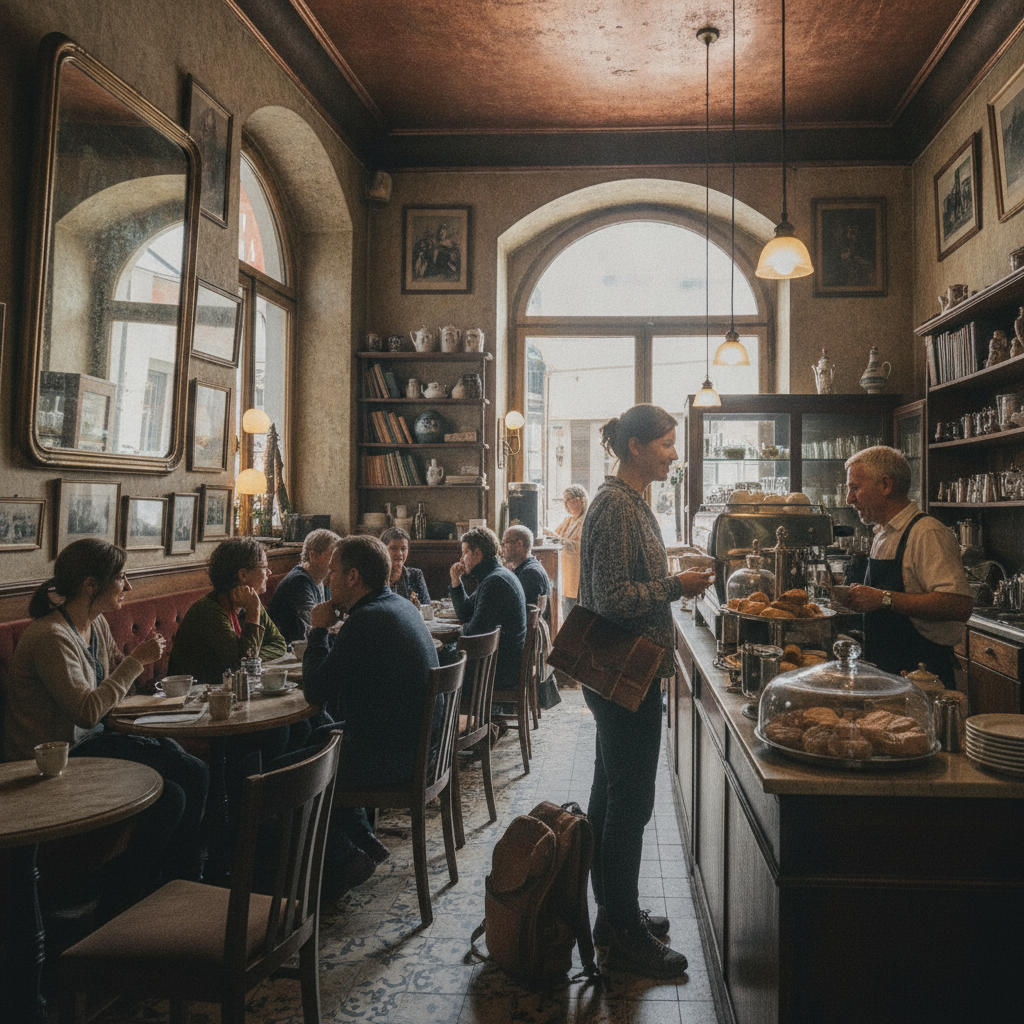
There is a particular kind of disorientation that settles in during the first few hours in an unfamiliar city. The hotel room is fine. The neighborhood looks roughly as expected. But something feels unresolved — a low-level restlessness that no amount of itinerary-checking quite fixes. What is missing, more often than travelers realize, is not a landmark or a meal recommendation. It is a place to belong to, even temporarily.
That sense of immediate belonging is what a city's oldest working café or tea house can provide — and it is something worth seeking out before you ever pack a bag.
The Difference Between a Stop and a Social Anchor
Most travel planning treats cafés and restaurants as stops: places to refuel between sights. An anchor is something different. It is a place with enough accumulated history and social gravity that simply sitting inside it connects you to something larger than the transaction of ordering a drink. The oldest continuously operating café in a city carries that weight almost automatically. Its regulars have a rhythm. Its staff have an institutional memory. Even as a stranger, you are walking into a place that has been receiving strangers for generations.
This distinction matters because it changes how you experience everything that follows.
Why Age Signals Something Specific About a Place
A café that has operated continuously for a century or more has survived economic collapses, political upheavals, and shifts in taste that eliminated its competitors. Places like Café Central in Vienna, which opened in 1876, or the Nanhua Tea House in Guangzhou, operating in various forms since the Qing dynasty, did not survive through accident. They survived because they filled a genuine social function — a function that still operates the moment you walk through the door. The physical environment, the rituals around ordering, the unhurried pace that older establishments tend to protect — all of it signals that this is a place designed for staying, not passing through.
The Pre-Arrival Research That Pays Off Immediately
Finding a city's oldest working café is not difficult, but it does require specificity in your search. The phrase "historic café" returns tourist-facing results that may be beautifully restored but recently reopened. What you are looking for is continuous operation — establishments that have never fully closed, even if ownership has passed between families. Local food historians, city-specific subreddit threads, and heritage organization websites tend to surface these places far more reliably than general travel platforms. Once identified, all that is required is to visit within the first few hours of arrival, before the itinerary takes over.
What Happens When You Sit Down Early
The effect of visiting on the first morning or afternoon is difficult to overstate. By the time you return — and most travelers do return to a place that gave them their bearings — the face of the person behind the counter is already familiar. The route there is already known. The city, which felt abstract from the hotel window, has acquired a center of gravity. Anthropologists use the term *lieu de mémoire* — a site of memory — to describe places that hold collective identity across time. Slipping into one of these sites early in a trip means that, for the duration of your stay, the city feels less like a set of coordinates and more like somewhere you have a small, earned relationship with.
The Social Architecture of Old Establishments
Older cafés and tea houses tend to share a particular interior logic. Seating is arranged for lingering rather than turnover. Natural light is managed rather than maximized. In traditional Arabic *qahwa* houses or the old *chashitsu*-influenced tea rooms of Kyoto, the physical design actively slows conversation and encourages the kind of unhurried observation that most modern travel never reaches. Even without knowing the local language, a traveler who sits quietly in these spaces tends to absorb more about local social behavior in an hour than a full day of structured sightseeing produces. The environment does the work.
Using the Café as a Soft Return Point
One underused travel strategy is building a soft return point into each day — somewhere that is not the hotel, not a restaurant with a reservation, but a place you choose to go back to simply because it feels right. The oldest café in a city performs this function particularly well because it requires no justification. Returning there at the end of an afternoon feels natural rather than planned. It gives the day a shape. Over the course of a week, these small returns accumulate into something resembling a local habit, which is perhaps the closest a traveler can get to genuine immersion without an extended stay.
A Practice Worth Carrying Forward
As travel patterns continue to shift toward slower, more intentional trips, the instinct to find a social anchor early is likely to become more deliberate rather than accidental. City heritage boards in places like Lisbon, Istanbul, and Hanoi are increasingly documenting their oldest operating establishments — partly for preservation, partly because the demand from thoughtful travelers has made such documentation worthwhile. The habit of identifying one anchor institution before departure takes perhaps twenty minutes of research. What it gives back — orientation, calm, a sense of being somewhere rather than just passing through — is disproportionate to the effort. That asymmetry is what makes it worth building into every trip, not just the occasional one.