The most memorable moments from any trip are rarely the ones that appeared in the itinerary. They tend to arrive sideways — through a wrong turn into a courtyard, a bakery that smelled too good to walk past, or a conversation with a shopkeeper who mentioned a neighborhood market that doesn't appear in any guidebook. Guided tours are designed for efficiency, and that efficiency comes at a cost: the serendipitous, unhurried quality of genuine discovery gets edited out in favor of logistics. Scheduling a deliberate half-day of aimless walking — no route, no agenda, no destination — consistently produces the kind of encounters that become the stories people tell for years.
The Case for Structured Aimlessness
There's a productive tension in the phrase "scheduled wandering," but it resolves itself quickly once a traveler actually tries it. The structure exists only in the time block itself — the half-day carved out before lunch, or the slow morning after a late arrival. What happens inside that block is entirely unscripted. This approach works because it removes the invisible pressure that governs most travel: the sense that every hour should be accounted for, every attraction ticked off. Without a map, the brain begins to operate differently, noticing details it would otherwise pass through — the texture of a doorway, the sound of a language shifting between two streets, the way a plaza empties between ten and eleven in the morning. Cities reveal their rhythms to those who slow down enough to watch.
The concept has a name in certain travel traditions. The French call it the *flânerie* — the practice of wandering through a city as a kind of aesthetic and social observation, associated with the literary figure of the *flâneur*, the unhurried urban stroller who absorbs atmosphere rather than consuming attractions. Japanese travel culture has a related sensibility in *burabura*, a word that describes leisurely, purposeless walking as a form of pleasure rather than a failure of planning. Both traditions recognize something that modern tourism tends to overlook: that cities are experienced best at street level, without an agenda.
What Guided Tours Are Actually Optimized For
Guided tours solve a genuine problem. They compress the essential highlights of a place into a manageable window, provide context that a solo visitor might never encounter, and remove the cognitive load of decision-making from someone who is still learning the city's layout. For a first-time visitor to a place like Dubrovnik or Marrakech, a two-hour walking tour with a knowledgeable local can unlock an enormous amount of historical and cultural understanding that would take days to piece together independently. That value is real, and dismissing it entirely misses the point.
But tours are optimized for breadth and accessibility, not depth or surprise. The route is fixed, the stops are predetermined, and the group dynamic — however friendly — creates a kind of collective experience that crowds out the individual. A tour of Barcelona's Gothic Quarter will cover the Cathedral of the Santa Creu, the Plaça Reial, and a handful of Roman ruins. What it won't cover is the unmarked doorway three blocks off-route that leads to a courtyard café used almost exclusively by residents of the surrounding apartment buildings. That café exists on no map. It surfaces only to those walking slowly enough, and curiously enough, to notice the sound of espresso machines behind an unassuming wooden door.
How to Make the Half-Day Work
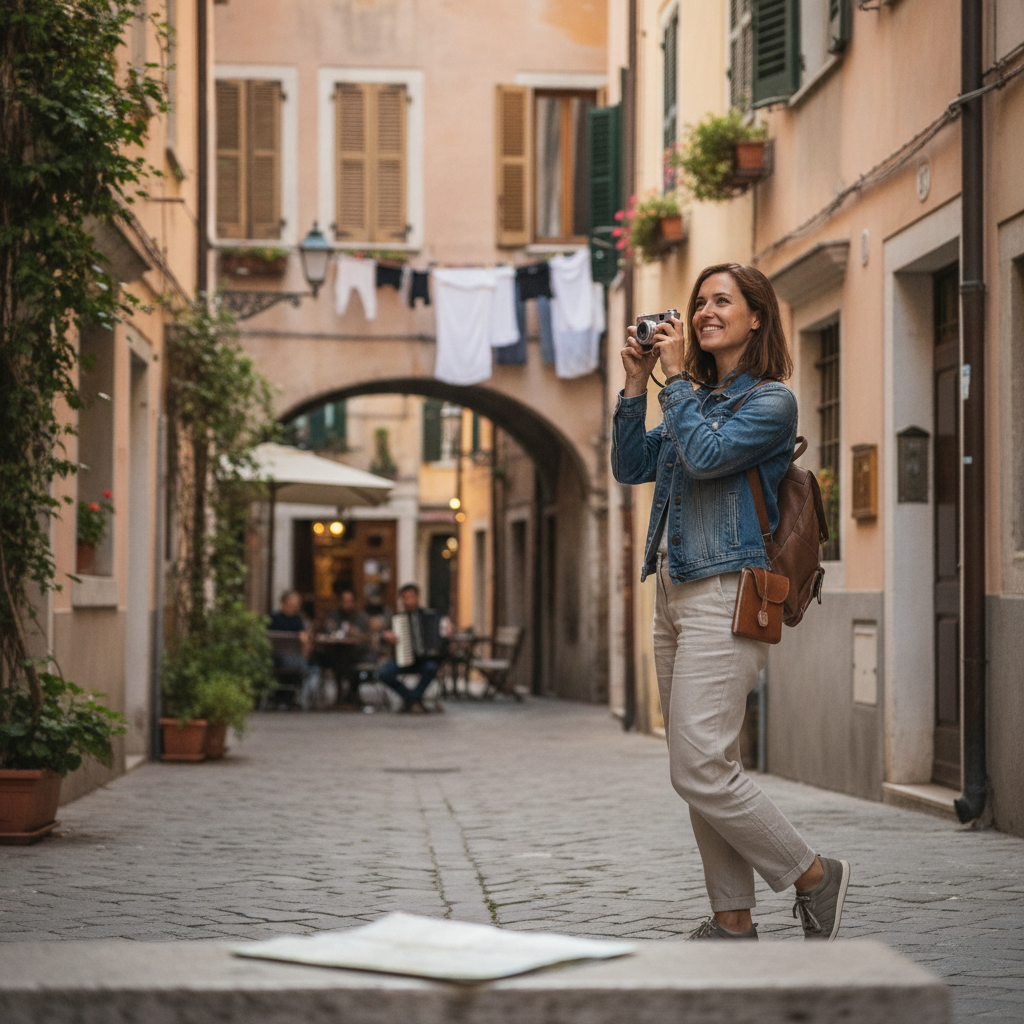
The mechanics are deliberately minimal. Choose a starting point that isn't a major tourist hub — a metro stop one or two stations from the center, a residential square on the edge of a neighborhood like Rome's Pigneto or Lisbon's Mouraria. Leave the phone in the bag, or at least close the navigation app. Walk toward whatever looks interesting from the immediate vantage point: a steeple, a hill, a cluster of awnings, the sound of a market. When a street looks appealing, take it. When a café looks lived-in, sit down. When someone is selling something from a cart, stop and look.
The key practice is resisting the urge to verify. The impulse to check Google Maps every few minutes is understandable — cities are large, and getting lost feels irresponsible — but getting mildly lost is precisely the mechanism by which the best discoveries happen. A rough sense of direction is enough. Knowing that the river runs east, or that the cathedral spire is visible from the high ground, provides sufficient orientation without eliminating the productive uncertainty that makes wandering valuable. Carry a small amount of local cash, wear comfortable shoes, and give yourself permission to not accomplish anything in particular.
The Kind of Experiences That Surface
What actually emerges from these half-days tends to fall into a few consistent categories. There are the local-facing establishments — the lunch spots, coffee counters, and small grocers that serve residents rather than visitors, places that feel utterly ordinary to the people inside them and quietly extraordinary to anyone arriving from outside. There are the architectural surprises: courtyards, staircases, rooflines, and facades that appear in no photograph because they don't photograph particularly well but feel remarkable in person. And there are the human encounters — the retired schoolteacher playing chess on a bench in a square in Porto, the textile vendor in Oaxaca who explains the difference between two shades of indigo that look identical to an untrained eye.
None of these experiences are guaranteed, and that's part of the point. The half-day without a map operates on a different logic than the rest of the itinerary — it's an investment in possibility rather than a plan with defined returns. The traveler who schedules it is essentially agreeing to show up fully present, without expectation, and to accept whatever the city offers. That posture, more than any specific technique, is what separates wandering from merely walking.
The traveler who ends their trip with a memory of a magnificent cathedral and a quietly vivid memory of a courtyard they stumbled into by accident will almost always speak more warmly about the courtyard. Not because cathedrals aren't worth seeing, but because discovery has a different quality than consumption — it feels earned, particular, and entirely one's own. Scheduling that half-day is simply the practical act of making space for it to happen.