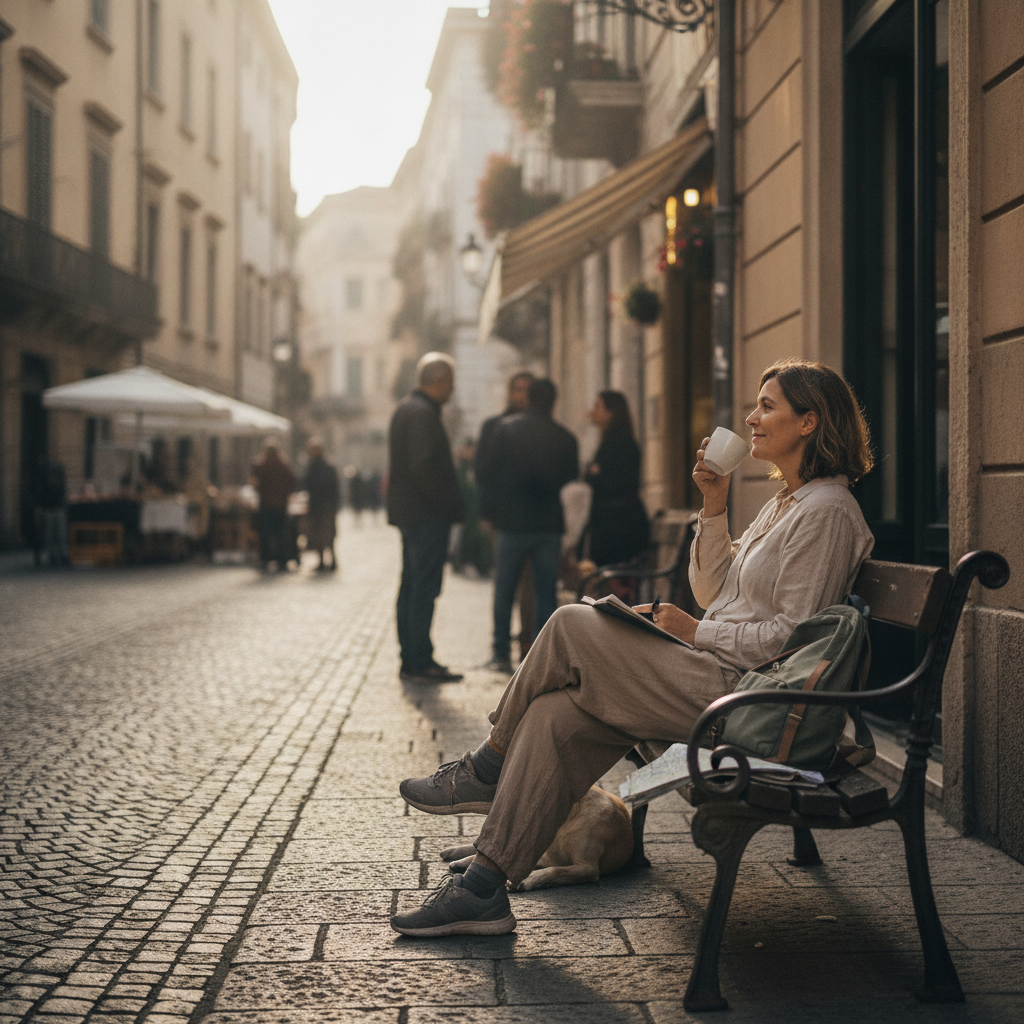
There's a particular kind of traveler who arrives in a new city, sets the alarm for 7 a.m., and has the first three hours mapped down to the quarter-hour. The museum opens at nine; the famous square is twelve minutes on foot; the recommended café closes by ten-thirty. It feels like efficiency. It feels responsible. And yet, years later, the memories that surface most vividly — the ones worth retelling — rarely come from those meticulous first mornings.
The unscheduled first morning of a trip occupies a unique psychological space. The body has adjusted to a new timezone, or is still adjusting. The senses are heightened — unfamiliar sounds through the window, the texture of different light, the smell of a city that hasn't yet become ordinary. This is precisely when the brain is most receptive to deep encoding of experience. Filling that window with a checklist of landmarks is a little like turning on the television the moment you sit down to think.
What Gets Lost in the Rush Toward Sights
Structured sightseeing serves a genuine purpose later in a trip. There are things worth seeing, and finite time in which to see them. But the first morning carries a different charge. It's the period when the traveler is still a stranger to the place — before the mental map forms, before the city becomes legible. That strangeness is not a problem to be solved with a rigid schedule. It's the raw material of genuine encounter.
When a traveler wanders into a neighborhood like Pigneto in Rome or the Canal Saint-Martin district in Paris without a destination, the city begins to reveal itself through texture rather than catalog. The sounds of a street market, a half-overheard argument, a dog sleeping across a doorstep — these details don't appear on any top-ten list, and they tend to be what people describe years later when asked about a trip.
The Psychology of Unstructured Discovery
Cognitive science offers a useful frame here, though the insight itself is intuitive. Memory formation is strongly tied to novelty and emotional engagement. A procession of famous sights, viewed on schedule, produces what might be called *museum fatigue* — a dulling of perception that comes from consuming experiences rather than inhabiting them. Unstructured time, by contrast, invites the kind of alert presence that makes moments stick.
There's also something to be said for *sérendipité* — a French-borrowed concept that captures the productive accident, the meaningful encounter that no itinerary could have predicted. The best travel stories almost always contain a sérendipité moment: the wrong turn that led somewhere better, the conversation that started because a map was unfolded in the wrong direction. These moments require a certain porousness to circumstance, a willingness to not already know where you're going.
The first morning, before routine sets in, is when that porousness is most naturally available.
Practical Rhythms That Support Unstructured Time
None of this is an argument against planning. The rest of the trip can be as structured as temperament demands. The point is narrower: protecting the first morning from the itinerary is a deliberate act that tends to yield disproportionate returns in both experience quality and memory richness.
A few patterns tend to support this approach. Staying in a residential area rather than a tourist district — somewhere like the Eixample neighborhood in Barcelona rather than the Gothic Quarter — means the first morning walk is already an encounter with ordinary local life rather than a procession of curated attractions. Keeping the phone pocketed for the first hour, or using an app like Maps.me only for rough orientation rather than turn-by-turn direction, preserves the sense of mild uncertainty that makes discovery feel real. Sitting in a local café without a purpose beyond coffee and attention is, genuinely, a form of seeing the place.
The Slower Logic of First Impressions
There's an older travel philosophy that knew this instinctively. The writers and wanderers who produced enduring accounts of place — in cities like Tangier, Kyoto, or Lisbon — tended to describe their first days as periods of deliberate idleness, of sitting and watching before attempting to understand. The structured sightseeing came later, if at all. The first impression was protected from the pressure of productivity.
This slower logic isn't nostalgia. It reflects something true about how humans absorb unfamiliarity. The brain needs time to do its work — to register difference, to begin constructing context, to let the new place become real rather than merely visited. Rushing that process by filling it with scheduled landmarks skips the most generative stage of the travel experience.
The traveler who spends the first morning without a plan isn't being careless. They're being strategic about something that doesn't show up in a spreadsheet: the quality of what they'll carry home.
Years from now, when you're asked about that trip, the famous square might surface as a name. But the memory with texture — the one with light and sound and the feeling of being genuinely somewhere — will almost certainly trace back to a moment that wasn't on the schedule. That's not coincidence. It's the reward for leaving a few hours open, at the start, before the city became familiar and the days became efficient.