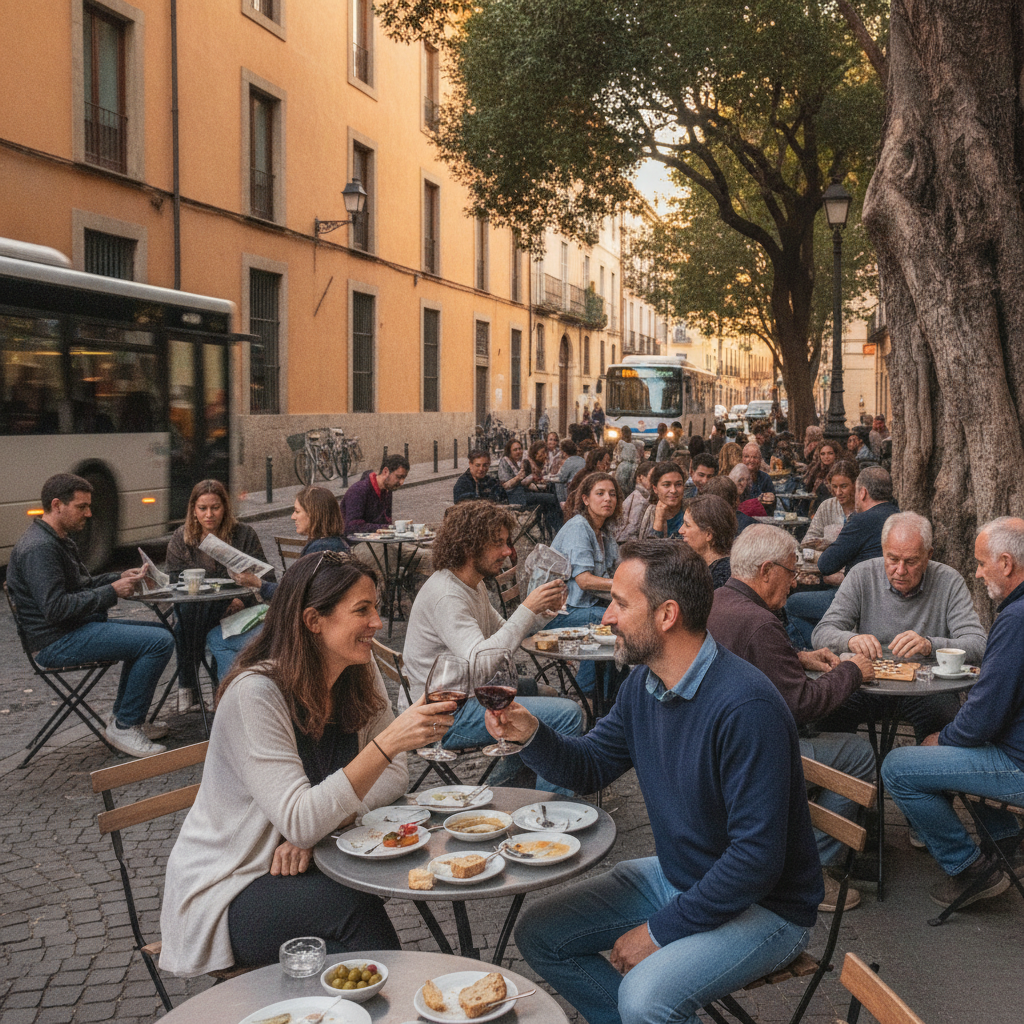
Travel memory is shaped less by what a destination offers at its most performative and more by what it reveals when no one is trying to impress. First-day tourist activities — the landmark queue, the hop-on hop-off bus, the restaurant recommended by the hotel concierge — are designed to meet expectations, not challenge them. A place presenting its highlight reel is not the same as a place simply existing. The final evening of a trip, spent quietly alongside locals on an ordinary weeknight, has a way of correcting everything the first day got wrong.
The Difference Between a City's Stage and Its Living Room
Every destination maintains two versions of itself simultaneously. There is the curated version — the one oriented toward visitors, polished at entry points, and priced accordingly — and there is the version that continues running regardless of tourist season. A Wednesday evening belongs almost entirely to that second version. Locals are stopping at a neighborhood bakery in Lisbon's Mouraria quarter on the way home, not because it has a good rating on an app, but because it has always been there. That distinction in motivation produces an entirely different kind of place to inhabit, even briefly.
Why First-Day Impressions Are Structurally Unreliable
Arrival day carries its own distortions. Travelers are oriented toward logistics — finding the accommodation, locating food, recovering from transit — and the emotional state of anticipation colors everything they encounter. The street food tastes remarkable partly because it is new. The neighborhood feels vibrant partly because the senses are heightened. These are real experiences, but they are filtered through novelty rather than familiarity. By contrast, the final evening carries a different quality of attention: quieter, more comparative, more willing to notice what is ordinary rather than what is extraordinary.
What Ordinary Wednesday Rhythms Actually Reveal
A local Wednesday evening in almost any city follows patterns that guidebooks rarely document. In Tokyo's Shimokitazawa neighborhood, that might mean small jazz bars filling with after-work regulars before nine, or izakayas where the conversation at the next table is about mundane professional frustration rather than sightseeing. In Bologna, it means university students occupying café terraces over a single drink for two hours without apology. These rhythms reveal the social infrastructure of a place — how people rest, how they relate to public space, and what pace the city actually runs at when it is not performing for outsiders.
The Psychological Shift That Happens on a Final Evening
By the last evening of a trip, a traveler has shed much of the urgency that drives early itinerary decisions. There is nothing left to optimize. The pressure to maximize each hour — to see the museum before it closes, to photograph the viewpoint at golden hour — has largely dissolved. What remains is the capacity to simply be somewhere without an agenda attached. That psychological condition is surprisingly close to what residents experience on an average evening, and it is precisely that shared state of unhurried presence that makes the encounter feel mutual rather than observational.
Finding the Right Spaces Without a Checklist
The neighborhoods where this kind of evening works best are almost always residential rather than central. In cities like Porto, Oaxaca, or Thessaloniki, those areas sit just far enough from the historic core that the businesses there cater to people who live nearby rather than people passing through. A produce market winding down for the day, a barbershop with chairs facing the street, a small supermarket where the selection tells you something about what people actually cook — these are unremarkable sights that collectively form a more honest portrait of daily life than any curated attraction. Google Maps and the app Spotted by Locals can help identify these pockets without over-engineering the discovery.
How to Spend Your Final Evening With Intention
The approach does not require elaborate planning, but a few deliberate choices make the difference. Pick a neighborhood at least two metro stops or a twenty-minute walk from your accommodation. Leave the camera in your bag for the first hour and resist the pull of any place with an English-language menu prominently displayed outside. Sit somewhere modest — a bench, a bar stool at a local café, a spot on a low wall near a small piazza — and stay longer than feels comfortable. Order whatever is simplest and cheapest. If you are in a city with a visible evening promenade culture, like Valencia's Ruzafa district or the streets around Tbilisi's Vake Park, follow that rhythm rather than creating your own. Let the evening's pace determine yours, not the other way around.
The final evening of a trip is, in many ways, the most honest one — not because the destination has changed, but because the traveler has. The willingness to spend it the way a resident spends a forgettable Wednesday is also a willingness to let a place be itself rather than a backdrop. That small act of restraint consistently produces a clearer, more durable impression of somewhere than any first-morning highlight could offer.