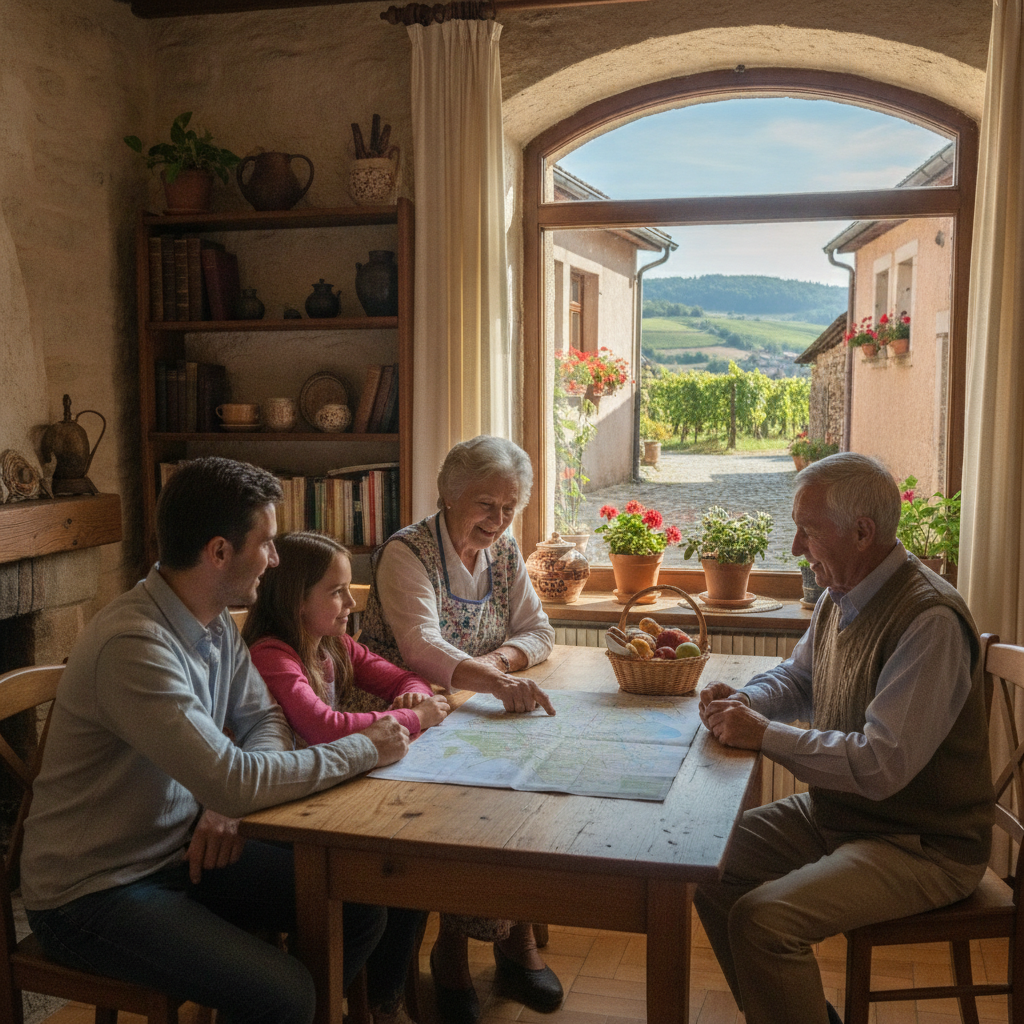
There is a particular kind of stillness that settles over a small town at seven in the morning — before the tourist trail stirs, before the cafés pull up their shutters — when the only sounds are the ones residents actually live inside. It is precisely in that stillness, often at a shared breakfast table in a family-run guesthouse, that the most useful travel knowledge tends to surface. Not the polished, SEO-optimised kind found in published guides, but the quietly specific kind: which road floods after heavy rain, which stall at the weekend market sells the best preserved lemons, which shortcut through the old quarter the locals actually use.
The Particular Economy of Small-Town Hospitality
Family-run guesthouses operate on a fundamentally different economy than chain properties. Their reputation is inseparable from the family's own standing in the community, which means the quality of the experience — including the information shared with guests — is a matter of personal pride rather than corporate metric. In places like Essaouira on Morocco's Atlantic coast or the hill towns of Umbria in central Italy, these properties have often been operated by the same household across multiple generations, accumulating a depth of local memory that no recently opened boutique hotel can replicate. The incentive to be genuinely useful is built into the model itself.
What Guidebooks Structurally Cannot Do
Published travel guides, even the most rigorously researched ones, carry an inherent lag. By the time a recommendation clears editorial, print, and distribution cycles, the restaurant it praised may have changed hands, the trail it mapped may have been rerouted, and the "hidden gem" it revealed may have been discovered by everyone else who read the same page. The family running a guesthouse in a small Oaxacan town or a remote village in the Alentejo region of Portugal updates their knowledge daily, almost without effort, simply by living there. They know when something closes, when something better opens, and why certain things are worth the detour on a Tuesday but not a Saturday.
Savoir-Faire and the Culture of Practical Guidance
In French, *savoir-faire* — literally "knowing how to do" — describes a practical, embodied knowledge that comes from sustained experience rather than study. Family guesthouse hosts tend to possess this in abundance. They know not just what to see, but how to move through a place efficiently and respectfully. A host in a guesthouse in Hoi An, Vietnam, might explain which time of day the lantern-lit streets feel genuinely atmospheric versus overwhelmingly crowded — information that shapes the entire character of a visit, and that no printed guide bothers to specify because it shifts seasonally, weekly, even daily.
The Trust Architecture of Shared Space
There is something about the physical intimacy of a family guesthouse that lowers the usual transactional register of tourism. Guests share breakfast rooms, communal gardens, and sometimes kitchen tables with their hosts. This proximity generates a different kind of conversation than the front-desk exchange at a chain property, where staff rotate shifts and follow scripted recommendations often tied to commission arrangements with local tour operators. In a family setting, recommendations tend to be personal rather than commercial. A host in a small guesthouse in Tbilisi, Georgia, is unlikely to send guests to a restaurant simply because it pays a referral fee — they're far more likely to mention the place their cousin considers the best in the district.
When Local Knowledge Becomes Practical Currency
For the practical traveler — the one trying to stretch a budget, avoid wasted hours, and spend time in places that feel real rather than staged — the informal knowledge available at a family guesthouse functions as genuine currency. It can redirect a day entirely: away from an overcrowded viewpoint toward a quieter one with an identical panorama, away from an overpriced tourist lunch spot toward a workers' canteen where the food is better and the bill is a fraction of the cost. This kind of intelligence is not the result of research; it is the result of presence, and no app or algorithm has yet found a way to replicate it reliably at scale.
Respecting the Knowledge That Is Offered
There is an implicit social contract embedded in this kind of hospitality. When a family shares their local knowledge with a guest, they are extending something personal — a piece of their daily life, their community relationships, their accumulated experience. Travelers who receive this information well, who follow the recommendation and return to mention what they found, who ask questions with genuine curiosity rather than entitled expectation, tend to unlock considerably more over the course of a stay. *Xenia*, the ancient Greek concept of hospitality as a sacred mutual obligation between host and guest, captures this dynamic well: the exchange works most generously when both parties bring something to it.
Why This Approach Consistently Outperforms the Alternative
If you choose to stay in a family-run guesthouse on your next small-town trip, the value proposition extends well beyond a comfortable bed at a reasonable rate. You are effectively gaining access to a locally embedded researcher who has been gathering relevant data for years, who has no incentive to mislead you, and who understands the specific texture of the place in ways that simply cannot be compressed into a star rating or a bullet-pointed highlights list. This is not a romantic notion — it is a practical one. The most useful information about any place tends to live in the people who belong to it, and a family guesthouse is, more often than not, the most direct point of access a traveler can find.
The stillness of that early morning, the shared table, the offhand remark about where the market actually gets interesting after nine — these are the things that reshape a journey from a checklist into something that feels worth the distance. The best travel knowledge has always worked this way: not written down, not searchable, but handed across a table by someone who simply knows.