Budget travel has always been measured in the wrong currency. The instinct to open a flight comparison app, filter by price, and book the cheapest available seat treats the journey as an obstacle rather than the experience itself — something to compress, survive, and discard. But for travelers moving between neighboring countries, the overland bus offers a fundamentally different kind of economy, one that counts not just what money is saved but what understanding is gained along the way.
The Hidden Cost of the One-Hour Flight
Flying between cities like Budapest and Vienna, or Chiang Mai and Luang Prabang, looks efficient on paper. The flight is short, the ticket sometimes cheap, and the logic seemingly airtight. What the comparison rarely includes is the full arithmetic of air travel: the taxi to a remote airport, the two-hour check-in buffer, the security theater, the baggage fees that appear only at payment, the separate taxi on the other end into a city center that airports are rarely built near. By the time the dust settles, a forty-minute flight has consumed the better part of a day and added costs that weren't visible at the point of booking. The bus, running directly between city centers, collapses that hidden overhead significantly. FlixBus routes across Central Europe and Greyhound-equivalent services across Southeast Asia routinely drop passengers within walking distance of accommodation, without the financial fine print.
What the Road Between Countries Actually Contains
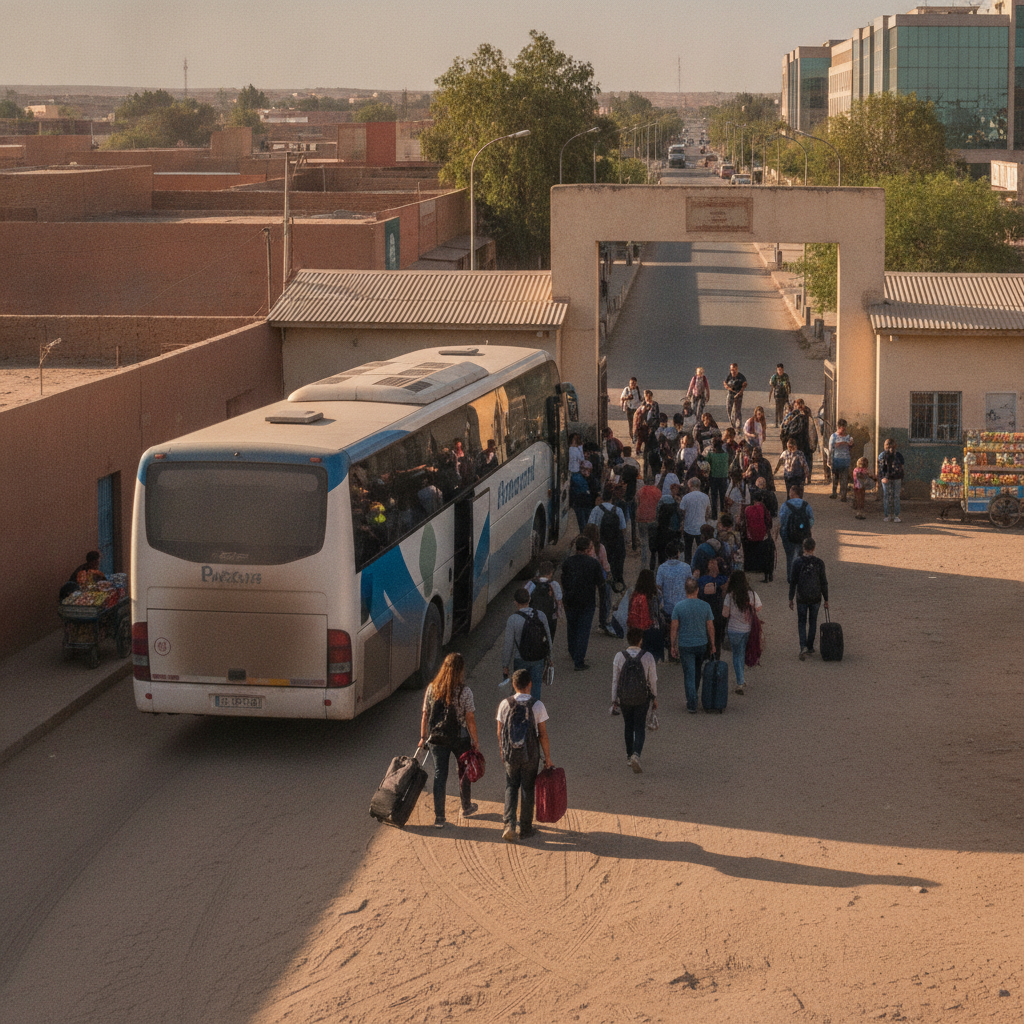
There is a concept in travel anthropology sometimes called the *entre-deux* — the French term for the in-between space, the threshold that exists between departure and arrival. On a bus crossing from Sarajevo into Mostar, or from Chiang Rai into Laos at the Huay Xai border crossing, that threshold is not compressed into a jetway and a seat-back screen. It is visible: the landscape shifts, the signage changes languages, the architecture of roadside towns tells a story about economic history, political geography, and agricultural tradition that no museum exhibit can replicate in quite the same way. The traveler who crosses by land witnesses the gradient rather than the jump. That perceptual difference is not a small thing — it is, arguably, the entire point of going somewhere unfamiliar in the first place.
Border crossings by land also carry their own social texture. The waiting, the document checks, the small interactions with fellow passengers who are often locals rather than tourists — these moments constitute what travel writers have long called *friction*, not as a complaint but as a feature. Friction slows the pace enough to make observation possible. A grandmother adjusting her bags in the overhead rack, a vendor selling tamales or bánh mì through the window at a rest stop, a customs officer waving a bus through with the practiced boredom of someone who has done it ten thousand times — these are the images that stay long after the hotel room has been forgotten.
The Economics of Slower Arrival
The financial case for the bus is real, but it operates differently than most budget calculations. It is not that the bus is always dramatically cheaper than the flight — sometimes it is, sometimes the gap is modest. The reframe is more structural. Traveling by bus between neighboring countries tends to consolidate several line items that air travel separates. Ground transport vanishes or shrinks because buses terminate centrally. Luggage fees disappear. The meal at a roadside stop in rural Thailand or a corner café in a provincial Hungarian town costs a fraction of airport food and delivers an experience worth remembering. The traveler who arrives in Vientiane by slow boat and bus from Chiang Mai has spent less, seen more, and arrived with a richer orientation to the place than someone who flew in and landed at Wattay International with no contextual memory of the surrounding region.
This is the deeper reframe budget travel demands: that the value of a journey is not calculated only by subtracting costs from a fixed figure but by asking what was received in exchange for what was spent. Time spent on a comfortable overnight bus is not wasted time — it is reading time, thinking time, or sleeping time that would have been spent anyway. The traveler isn't losing hours; they're relocating them.
Crossing as Cultural Orientation
For travelers who arrive somewhere without having crossed the surrounding terrain, a city can feel extracted from its context — a destination that exists in isolation rather than in relation to everything around it. The overland arrival corrects this. Someone who takes the bus from Tbilisi into Yerevan arrives understanding something visceral about the Caucasus that the airport arrival forecloses: the vastness of the plateau, the way the sky changes, the shift from Georgian script to Armenian alphabet on roadside billboards. That orientation shapes how the destination is perceived from the first hour. The city feels placed rather than dropped into.
There is also the practical cultural fluency that comes from handling a border crossing independently. Understanding the *aduana* process in Latin America — the customs declaration procedure at land crossings — or knowing to have physical document copies at Schengen-adjacent overland posts: these are forms of travel literacy that compound across trips. They build confidence and reduce the ambient anxiety that makes unfamiliar travel feel more stressful than it needs to be.
Rethinking What Budget Actually Means
Budget travel, at its best, was never about deprivation. It was about allocation — spending less on the parts that don't matter in order to have more for the parts that do. The airport experience doesn't accumulate into memory the way a border town does. The forty-dollar saved on a bus versus a flight is real, but secondary to the larger point: that the traveler who crosses by land returns not just having saved money but having understood something more completely. That distinction is what separates a cheaper trip from a richer one, and it's a distinction worth making before the next booking window opens.
The instinct to minimize the journey in favor of the destination is understandable — time is genuinely limited, and not every crossing warrants a philosophical reframe. But for neighboring countries with overland connections worth taking, the bus is rarely just the cheaper option. It's the option that keeps the trip honest, keeps the traveler present, and keeps the experience from being reduced to a transaction. That is what budget travel, at its most meaningful, has always been trying to say.