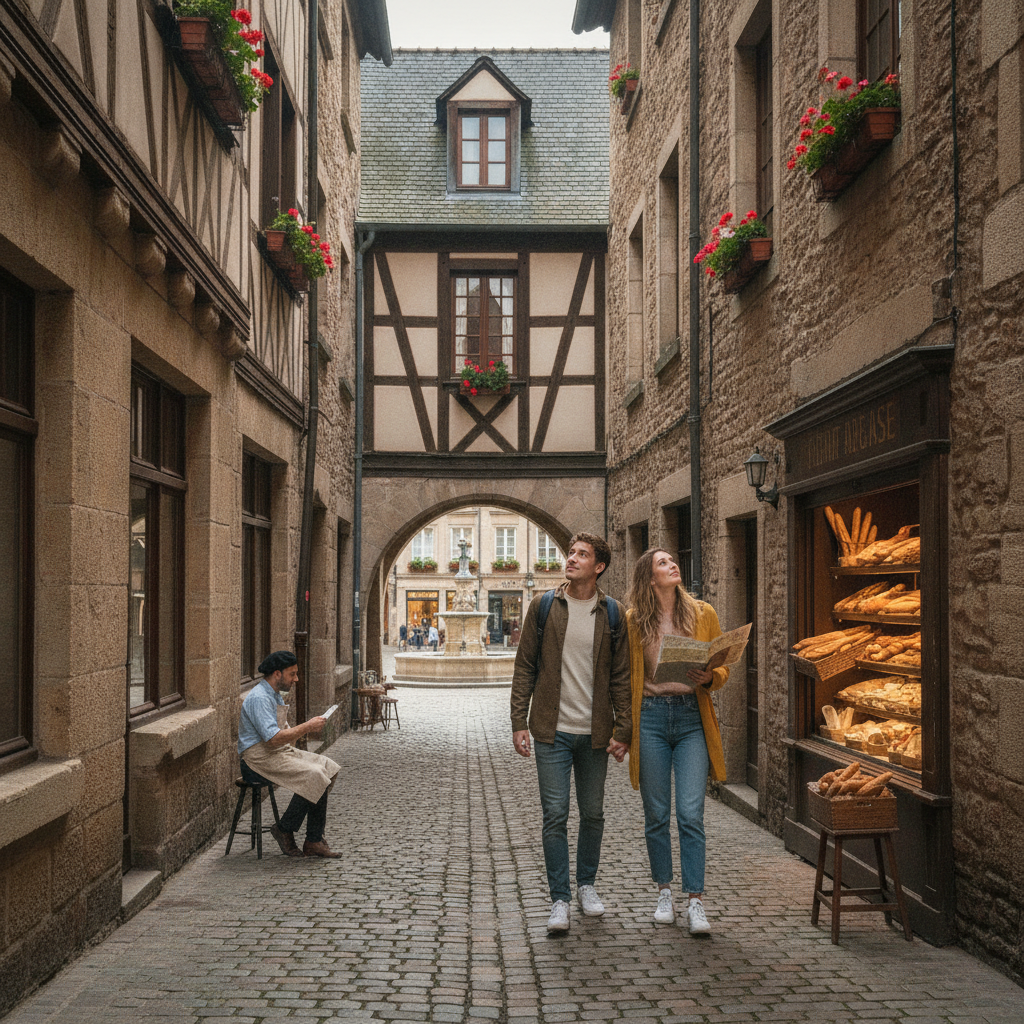
There is a particular kind of traveler who arrives in a city and immediately feels at home — not because they've been before, but because they've placed themselves somewhere that has been lived in for centuries. The choice of where to sleep is rarely treated as a meaningful decision, tucked behind the larger considerations of flights, itineraries, and budgets. But that choice — specifically, the decision to base oneself in a city's oldest surviving residential quarter — quietly restructures every judgment that follows. It changes where you eat, how you move, what you notice, and ultimately, what you remember.
The Architecture of Everyday Life
Old residential quarters — the Alfama in Lisbon, the Jordaan in Amsterdam, the hutong districts of Beijing — were not built for visitors. They were built for people who needed to get bread in the morning, carry water up a hill, and find shade in the afternoon. The street widths, the placement of fountains, the angle of doorways: all of it reflects a logic of daily life rather than a logic of spectacle. When a traveler bases themselves inside these layers, the built environment begins to communicate in ways that museums and guidebooks cannot. The scale of the streets alone — often too narrow for modern traffic — enforces a pedestrian pace that realigns attention. What might have seemed like an inconvenience on a hotel booking site becomes, in practice, a structural invitation to slow down.
This physical context shapes the traveler's relationship with the city almost involuntarily. A person walking to a corner bakery at seven in the morning is not a tourist performing an authentic experience; they are simply a person who is hungry and nearby. The distinction matters more than it sounds. Old quarters operate on rhythms — the vegetable delivery, the school run, the mid-afternoon quiet — and a traveler embedded in one of these neighborhoods begins to absorb those rhythms rather than cutting across them. The result is a kind of temporal literacy that no amount of sightseeing replicates.
How Location Rewires the Itinerary
Staying in an older residential quarter removes a layer of logistical mediation that hotel districts almost always introduce. The traveler no longer needs to commute into the city to find it — they are already inside something that predates the tourist infrastructure by several centuries. This repositioning has practical consequences. Meals are no longer planned around restaurant recommendations alone; they happen where and when hunger coincides with proximity. The small trattoria that has served the same neighborhood lunch for forty years becomes a natural option, not because it appeared on an app, but because it is simply there, smelling of garlic and olive oil, at noon.
The itinerary, too, loses its rigidity. When the morning walk to a café passes three things of interest, the day's shape adjusts to accommodate them. The Trastevere neighborhood in Rome, for instance, offers this quality with particular generosity — a traveler based there will cover more ground of genuine interest on a morning errand than they would on a structured tour of equal duration. What this means practically is that the traveler spends less time planning and more time encountering. The planning budget — the cognitive energy most travelers burn before breakfast — reallocates itself toward absorption rather than coordination.
The Cultural Terms That Tell You Where You Are
Every old residential quarter carries with it a vocabulary that doubles as a map. The *riad* of Marrakech's medina is not merely an architectural style; it is a philosophy of inward-facing life, where the courtyard replaces the street as the social center. The *kampung* neighborhoods of Kuala Lumpur represent a form of urban village — dense, communal, and organized around informal networks of mutual recognition. Understanding these terms, even loosely, before arriving gives the traveler a framework for what they're seeing. It transforms observation from passive to interpretive. A narrow alley in a Moroccan medina reads differently when you understand that it was designed to slow invaders, channel breezes, and create shade simultaneously — a triple function that no modern street achieves.
These linguistic and cultural markers are rarely explained on hotel booking pages, which is part of why the choice of accommodation so often misses them entirely. A traveler staying in a business hotel near a city's financial district experiences a thoroughly modern layer of that city — functional, neutral, and largely interchangeable. A traveler in an old quarter experiences the sediment of the place: the decisions made over generations about how to live, work, grieve, and celebrate in close proximity to neighbors.
What You Begin to See Differently
Once you position yourself inside one of these older neighborhoods — the Gion district of Kyoto, the Šнирата stari grad of Sarajevo, the Le Marais of Paris — the relationship between monument and everyday life inverts. The famous landmarks don't disappear, but they recede from center stage. You start noticing things that have no entry in any guidebook: the way light falls on a particular wall at four in the afternoon, the sound a fountain makes against stone in the early morning, the specific blue of a painted door that appears on three streets in a row for reasons no one alive can fully explain. These observations accumulate into something that feels, by the end of a trip, more substantial than any checked-off landmark.
There is also the question of social access. Older residential quarters tend to have their own interior social life — the old men who play cards outside the same café each afternoon, the market vendor who keeps the same position for decades, the neighborhood festival that appears on no tourist calendar because it was never intended for tourists. A traveler who is present long enough, and consistently enough, begins to be recognized as a temporary fixture rather than a passing stranger. That shift in status, however modest, changes what is offered and what is revealed.
Making the Decision Before You Book
For those planning a trip with this in mind, the practical consideration is straightforward: identify the old residential quarter before identifying the accommodation type. Most major cities and many smaller ones retain at least one district where the residential fabric predates the twentieth century — sometimes by several hundred years. Apps like Airbnb have made it significantly easier to rent within these areas at a range of price points, and many cities have seen a growth in boutique guesthouses operating out of heritage buildings in exactly these neighborhoods. The key is to prioritize location over amenities. A smaller room in the right street is worth considerably more, experientially, than a larger room in a generic district.
When you make that choice — when you commit to a narrow street, a slightly inconvenient address, a neighborhood that doesn't feature on any hotel shuttle route — you are making every subsequent decision from the inside rather than from the outside. The meals, the walks, the unexpected conversations, the mornings that don't go according to plan: all of it unfolds against a backdrop that is already doing half the work. The city is not something you visit from your room. It is something you wake up inside, and the oldest quarters are where that feeling is most fully earned.