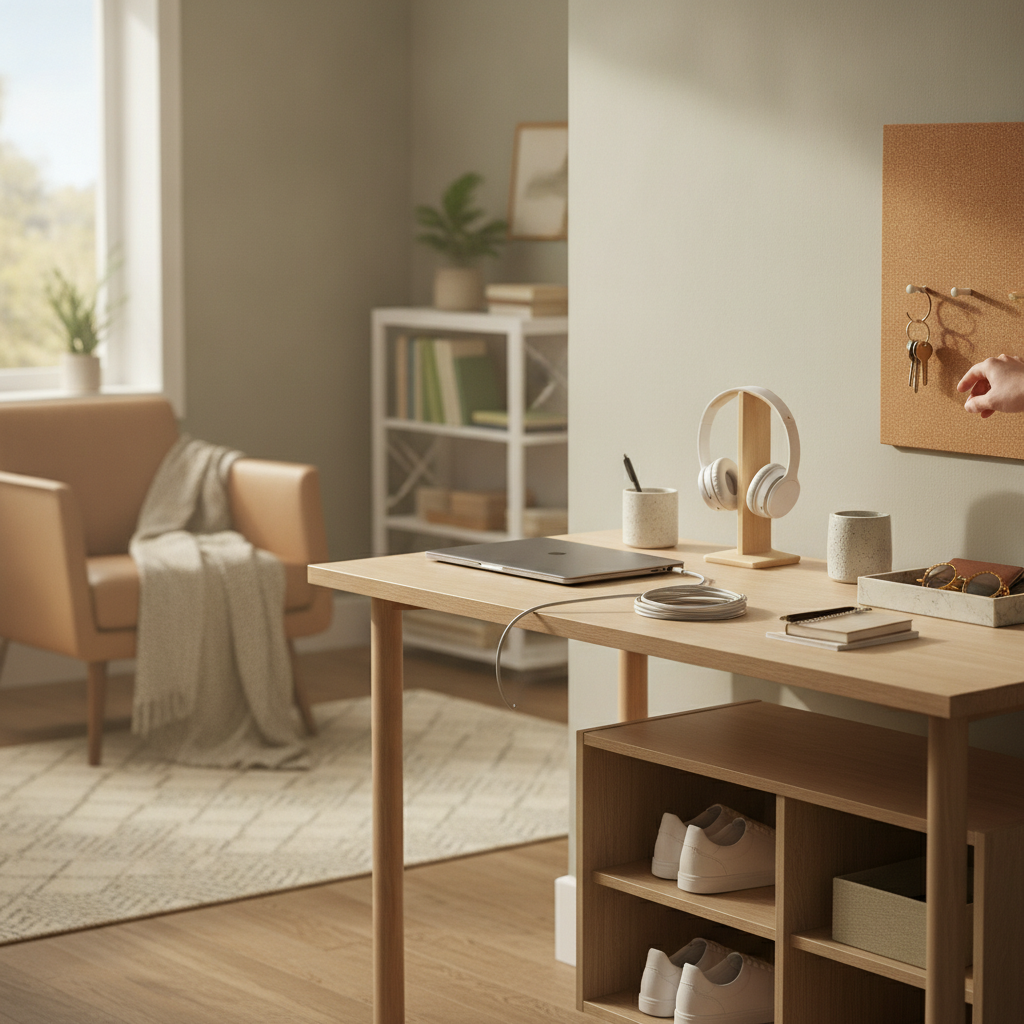
Small frustrations have a way of accumulating quietly. The ten minutes spent hunting for your phone charger before a meeting, the frantic scan of every surface for your keys before leaving the house, the low-grade irritation of not knowing which drawer holds the scissors — none of these feel significant on their own, but together they carve a real and measurable chunk out of your day. What makes this particularly draining is that the mental effort doesn't stop when the object is found. The interruption lingers, pulling your focus away from whatever you were doing before the search began.
The fix isn't a new app or a weekend overhaul. It's a deceptively simple principle: every object you own needs a single, non-negotiable physical address inside your home.
Understand Why Homeless Objects Are a Hidden Tax
When an object doesn't have a designated spot, you make a micro-decision every time you set it down. Where should this go? Is this a good place? You rarely register these decisions consciously, but your brain absorbs the cost. Multiply that by dozens of objects across an entire day, and you've quietly spent a significant portion of your cognitive budget on logistics rather than anything that actually matters to you. The goal of assigning fixed homes isn't tidiness for its own sake — it's reclaiming that mental bandwidth for better use.
Start With the Objects You Touch Most Often
Rather than tackling your entire home at once, begin with the items that create the most daily friction. Keys, wallet, phone, glasses, and bag are strong starting points because you handle them every day and their absence costs you the most time. Choose a single, logical spot for each — a hook by the door, a small tray on the entryway table — and commit to it without exception. The Container Store and IKEA both carry narrow entryway organizers that make this easy without requiring structural changes to your space. Consistency in these high-frequency items alone produces a noticeable shift within a week.
Choose Locations Based on Use, Not Appearance
The most common mistake in home organization is placing objects where they look good rather than where they get used. A beautiful charging station in the bedroom means nothing if you always need your phone in the kitchen in the morning. Think about the specific moment you reach for each object, then assign its home as close to that moment as possible. The charger lives by the coffee station. The scissors live in the room where packages get opened. When the home makes contextual sense, returning objects to it becomes automatic rather than effortful.
Create a Return Ritual, Not Just a Storage System
Assigning locations only works if returning objects to those locations becomes a reflex. The most reliable way to build that reflex is to attach the return moment to something you already do consistently. When you walk through the door, keys go on the hook — every time, before you do anything else. When you finish using the tape measure, it goes back in the kitchen drawer before you walk away. Toggl's research into habit formation backs what most behavioral science has long suggested: the more automatic the return action, the less decision fatigue the system creates over time.
Handle the Awkward Middle-Ground Items
Some objects resist easy categorization — library books waiting to be returned, items borrowed from a friend, packages that need to go back to Amazon. These tend to pile up on counters because they have no obvious permanent home. A single designated outgoing zone solves this cleanly. One basket near the front door, one shelf in the entryway, one spot on the kitchen counter — whatever you choose, all transitional objects live there until they leave the house. This prevents the slow creep of temporary clutter that gradually colonizes your permanent surfaces.
Apply the Same Logic to Digital Accessories
Chargers, cables, adapters, and earbuds generate a disproportionate amount of daily searching relative to their size. Because they're small and easy to carry into multiple rooms, they rarely settle in a consistent place. Assign each one a fixed home — a specific drawer, a labeled cable organizer, a dedicated compartment in your bag — and treat moving them as a temporary action rather than a permanent relocation. Anker and Belkin both make compact cable organizers that slot into most desk drawer setups without taking up meaningful space. Treating accessories as seriously as larger items closes a surprisingly common source of daily friction.
Audit for Homeless Objects Once a Season
Even a well-organized home develops drift. New purchases arrive without assigned spots. Objects get moved during cleaning and never return to their original location. Setting aside twenty minutes once a season — just four times a year — to walk through your space and identify anything without a clear home keeps the system from quietly unraveling. Think of it as a light maintenance pass rather than a reorganization project. You're not starting over; you're simply catching the handful of items that slipped through and giving them a defined address before they start generating search costs again.
Resist the Urge to Over-Engineer the System
Labeled bins, color-coded zones, and elaborate drawer dividers can all be useful, but complexity tends to work against long-term consistency. A system with too many rules is harder to maintain when life gets busy. The goal is a home simple enough that you can follow it automatically, not a system that requires conscious effort to operate. Start with clear, obvious spots and let the structure evolve naturally as you notice what works. The best organizational system is always the one you'll actually use on an ordinary Tuesday when you're tired and distracted.
Giving every object a fixed home doesn't require a renovation or a free weekend. It starts with one high-friction item, one specific spot, and one consistent return habit. Once the pattern is established, it tends to expand on its own — because the relief of reaching for something and finding it exactly where you expect it is its own reward. Pick one object today, give it a permanent address, and let that small act be the beginning of a quieter, more functional home.