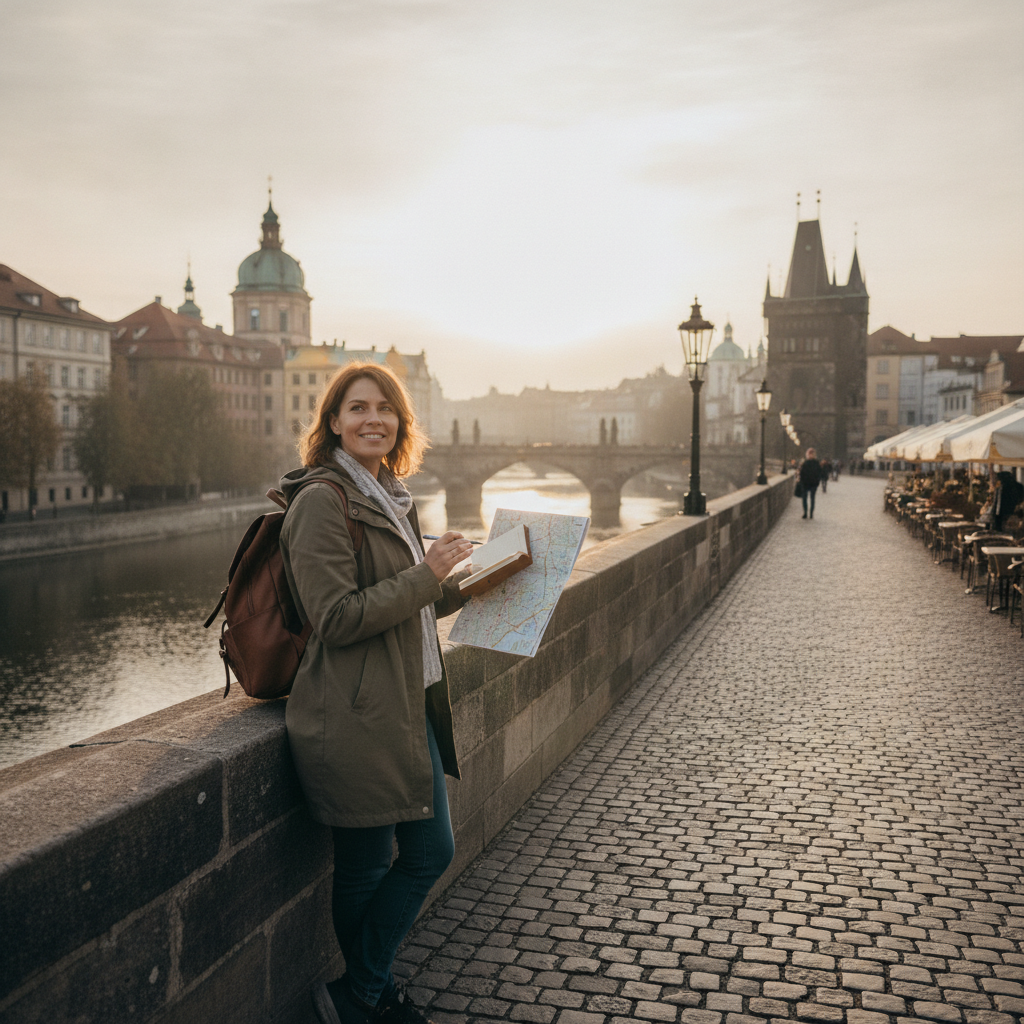
There is a particular kind of clarity that comes from walking into a place before the noise of a group arrives. The streets feel legible. The transit map makes sense. The hotel lobby, the corner café, the slightly confusing one-way system near the old market square — all of it settles into comprehension at a pace that shared travel rarely allows. The solo arrival buffer, as seasoned independent travelers have come to think of it, is less a logistical trick than a philosophical stance: the belief that a city deserves to be met quietly before it becomes a shared social project.
The Cognitive Load of Group Travel
Group travel is, by its nature, a negotiation. Every decision — where to eat, which metro line to take, how long to linger at a particular street market — passes through a social filter before it becomes action. This is part of what makes it joyful, but it also means that individual orientation rarely gets the quiet attention it requires. Cognitive load in unfamiliar environments is genuinely high: new signage systems, unfamiliar currency denominations, different pedestrian norms, the subtle social codes of a culture that take time to read. When those demands arrive simultaneously with the social demands of managing a group, the brain is working harder than it appears to be. Arriving one day early redistributes that load across time rather than compressing it into the first overwhelming hours.
Spatial Memory Built at Your Own Pace
Urban psychologists and experienced travel writers have long observed that spatial memory — the internal map a person builds of a new place — forms most reliably through slow, self-directed movement. Walking from the accommodation to the nearest metro station without consulting Google Maps every thirty seconds, noticing the bakery that doubles as a landmark, understanding that the neighborhood around Barcelona's Eixample grid behaves differently from the Gothic Quarter's medieval tangle — these are the kinds of low-pressure observations that embed themselves usefully. A solo pre-arrival day provides exactly the unhurried conditions that spatial learning prefers. By the time the rest of the group lands, the early arrival already carries a quiet internal compass that proves consistently useful over the days that follow.
This navigational fluency has a social dividend, too. Within a group, there tends to be an informal hierarchy of confidence — the person who seems to know where things are, who spots the better entrance to a museum or suggests the smarter route back from dinner. That role, which so often defaults to whoever researched the trip on paper, can just as naturally belong to whoever walked the streets first. Local knowledge acquired through direct experience carries a different quality than knowledge acquired through a travel app. It includes texture: the café that looks promising from the outside but has slow service, the shortcut that saves ten minutes on foot, the metro exit that drops you at the wrong end of the platform.
The Psychological Shift of Arriving Without Agenda
There is a Japanese concept, *ma* (間), that describes the meaningful quality of empty space or pause — the interval between notes that gives music its breathing room. A pre-arrival day functions something like *ma* within the larger structure of a trip. It is not downtime in the sense of wasted time; it is the gap that allows everything subsequent to land with more clarity. Travelers who arrive early consistently describe a shift in psychological register: a reduction in the reactive, slightly anxious state that characterizes the first day in an unfamiliar place, replaced by something closer to settled curiosity. The city no longer feels like a problem to be solved under social observation. It becomes, at least briefly, simply a place to exist in.
This matters more than it might seem. Anxiety in new environments often manifests as social irritability — the low-grade friction that can define the early hours of a group trip as people adjust to both the place and each other's travel personalities simultaneously. The early arrival sidesteps that overlap. By the time the group assembles, the solo day has already absorbed the friction privately.
Practical Gains That Accumulate Quietly
Beyond the psychological register, the practical advantages of a pre-arrival day compound steadily. Accommodation check-ins are smoother when handled without a group audience. Neighborhood grocery stores can be identified — useful for buying breakfast items or snacks that reduce daily spending, particularly in higher-cost cities like Zurich or Copenhagen. SIM cards and transit passes can be sorted without time pressure. The difference between arriving in Tokyo and understanding immediately that the IC card system (a rechargeable transit card used across trains and buses) works across multiple lines, versus learning that on day two with seven people waiting, is not trivial. Small logistical frictions, resolved in advance, simply don't become group problems.
There is also the matter of restaurant reconnaissance. Stumbling across a genuinely good local *trattoria* in Rome's Prati neighborhood during a solo afternoon walk, then bringing the group there on day two, is a different experience than consulting a review aggregator in real time with eight people standing on a corner. The former feels like local knowledge. The latter feels like what it is.
What You Carry Into the Shared Days
When you arrive a day before your group, you bring something intangible into the collective experience that no amount of pre-trip research quite replicates. You carry a felt sense of the place — its rhythm, its sounds at different hours, which streets feel welcoming and which feel merely transactional. That embodied familiarity shapes how you move through shared days: with less urgency, more willingness to pause, a quiet confidence that doesn't need to announce itself. The group trip, when it begins, starts from a slightly higher baseline of ease. The navigational stress that so often defines the first shared day is already metabolized. What remains is the part that travel is actually for — the accumulation of shared moments in a place that, at least for one person in the group, already feels a little like home.